Retail Investors Are Trading at Record Levels in 2026: What It Means for Your Portfolio
Retail investor trading has surged to some of the highest levels on record in 2026, with individual investors now accounting for roughly a third of all U.S. equity trading volume on many days. For everyday investors, the headlines about record participation raise a natural question: does this change how I should be investing? This article looks at what’s driving the surge in retail trading, the risks of getting swept up in short-term momentum, and how long-term investors can stay disciplined regardless of what the crowd is doing.
Retail Trading Volume Hits New Highs
According to data compiled by the Securities Industry and Financial Markets Association (SIFMA) and market-structure firm MEMX, retail investors made up roughly 17.9% of total U.S. equity trading volume in 2024 — a share that had been relatively stable for several years. That changed quickly. Reuters reported that retail participation climbed to an average of roughly 22% in 2025, with a single-month peak near 35% in April 2025 amid heightened market volatility. Year-to-date in 2026, retail investors’ share of trading volume has held around 35%, according to multiple market-data providers, making July one of the most active months of the year for individual investors, trailing only January.
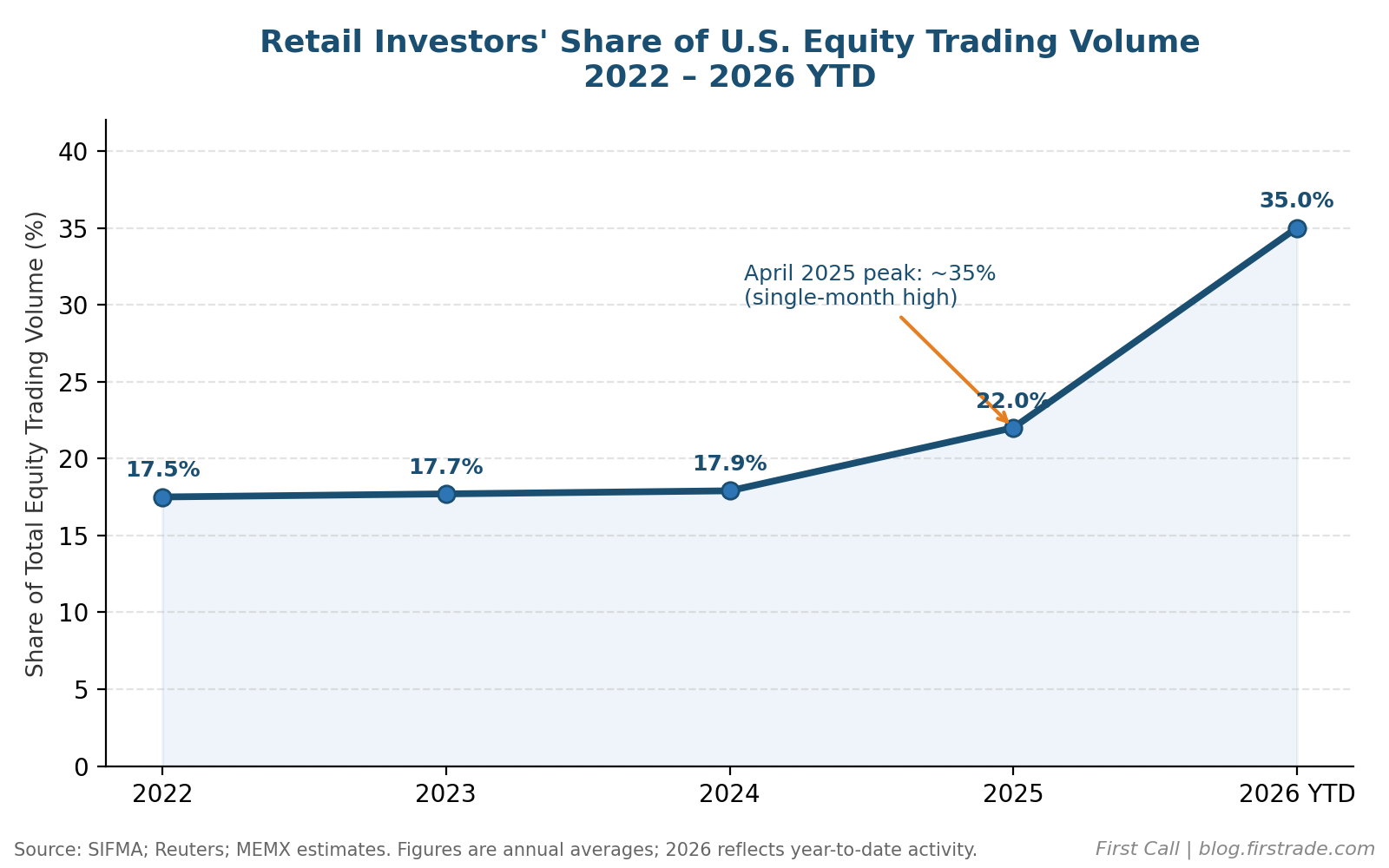
Retail investors’ share of U.S. equity trading volume, 2022–2026 YTD. Source: SIFMA; Reuters; MEMX estimates.
Retail inflows into U.S. stocks have followed a similar trajectory. Data cited by Reuters shows retail investors poured a record amount of new money into U.S. equities in 2025 — surpassing the previous high set during the 2021 "meme stock" period by roughly 14%.
Why Are More Individual Investors Trading Right Now?
A few forces appear to be driving the increase. Commission-free trading, fractional shares, and mobile-first brokerage tools have lowered the barrier to entry for new investors over the past several years. At the same time, a strong first half for U.S. equities in 2026 — with technology stocks posting outsized gains — has drawn attention (and capital) from investors hoping to participate in the rally. Elevated options activity, including a record volume of contracts tied to individual stocks, also suggests that some of this activity reflects more active, short-term trading strategies rather than long-term buy-and-hold investing.
The Risk of Chasing the Crowd
Rising participation isn’t inherently good or bad, but it’s worth understanding the risks that can come with it. When trading activity becomes concentrated in a small number of popular stocks or sectors, prices can become more volatile and more sensitive to sentiment shifts. Investors who buy simply because "everyone else is buying" can end up entering positions at elevated valuations, with little room for error if sentiment reverses. Chasing momentum can also lead to more frequent trading, which increases the odds of costly, emotionally driven decisions — buying near highs out of fear of missing out, and selling near lows out of panic.
How to Stay Disciplined When Everyone Else Is Trading
Long-term investors don’t need to change course just because trading volumes are elevated. A few habits can help:
Revisit your plan, not the ticker tape. A well-built diversified portfolio is designed to weather periods of high volatility and heavy trading activity.
Consider dollar-cost averaging. Investing a fixed amount on a regular schedule can reduce the temptation to time entries based on short-term sentiment.
Diversify across sectors and asset classes. Concentration in a handful of high-flying stocks increases the impact of a single sector pullback.
Separate "trading" money from "investing" money. If you want to participate in shorter-term opportunities, consider doing so with a small, clearly defined portion of your portfolio.
Retail vs. Institutional Trading: A Quick Comparison
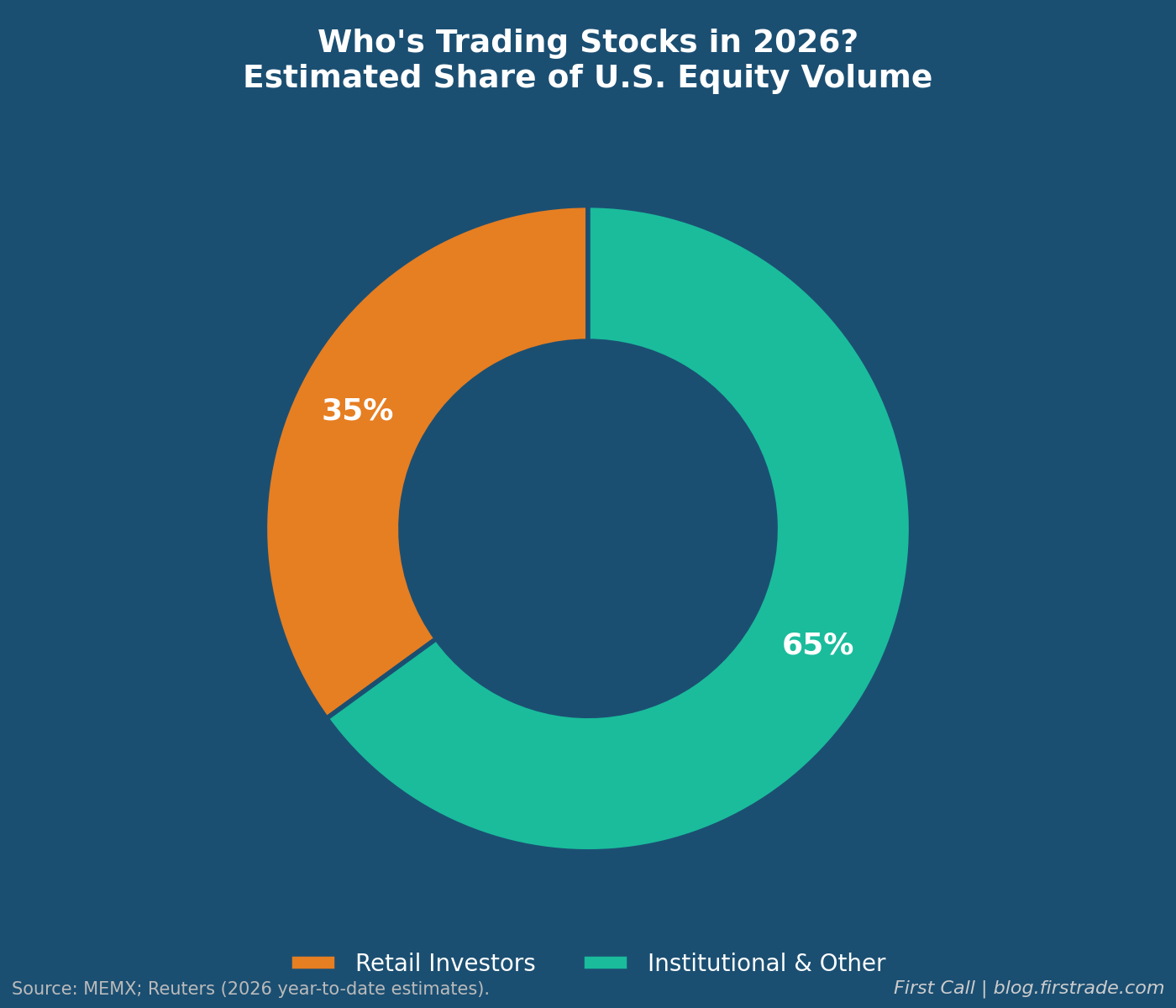
Estimated share of U.S. equity trading volume, 2026 YTD. Source: MEMX; Reuters estimates.
Frequently Asked Questions
Is high retail trading volume a warning sign for the market?
Not necessarily. Elevated retail participation reflects broader access to markets and strong investor interest, but it is one of many data points analysts watch. It doesn’t, by itself, predict future market direction.
Should I change my investment strategy because more people are trading?
Generally, no. A long-term financial plan should be based on your own goals, time horizon, and risk tolerance — not on how actively other investors are trading in a given month.
What’s the difference between trading and investing?
Trading typically involves shorter holding periods and more frequent buying and selling based on price movements. Investing generally involves holding assets for longer periods based on fundamentals and long-term goals. Both carry different risk profiles and tax implications.
The Bottom Line
Record retail trading volume in 2026 is a reminder of how accessible the markets have become — but it isn’t a signal to abandon a long-term plan. Understanding why participation is rising, and recognizing the risks of chasing short-term momentum, can help investors make more informed decisions regardless of what the crowd is doing.
This article is for educational and informational purposes only and does not constitute investment, legal, or tax advice, nor is it a recommendation to buy or sell any security. Investing involves risk, including possible loss of principal. Asset allocation and diversification strategies do not guarantee a profit or protect against loss. Past performance is not indicative of future results. Firstrade Securities Inc. is a member of FINRA and SIPC.