The 2026 Contribution Limits Just Went Up: What That Changes About Funding Your Accounts This Year

The IRS has raised how much you can put into tax-advantaged retirement accounts in 2026, and the increase is not just trivia — it changes how much room you have left and how you should pace your contributions before two different deadlines. If you set your contribution rate a year ago and have not touched it since, you are very likely leaving some of that new room unused.
The gap is easy to miss precisely because nothing prompts you to revisit it: payroll simply keeps deducting last year's number, and an IRA you funded in the spring sits at last year's ceiling. Here is what changed, what it means for your own accounts, and a four-step way to put the higher limits to work before the year ends.
What Actually Changed for 2026
For 2026, the employee contribution limit for 401(k), 403(b), most 457 plans and the federal Thrift Savings Plan rose to $24,500, up from $23,500. The combined limit for traditional and Roth IRAs climbed to $7,500, up from $7,000, and the SIMPLE plan limit rose to $17,000. These are the ceilings the IRS sets each year; what you actually put in is up to your budget and the deadlines below. It pays to act early rather than late: a 401(k) increase only affects the paychecks that come after you change it, so the sooner you raise the rate, the more of the year works in your favor.
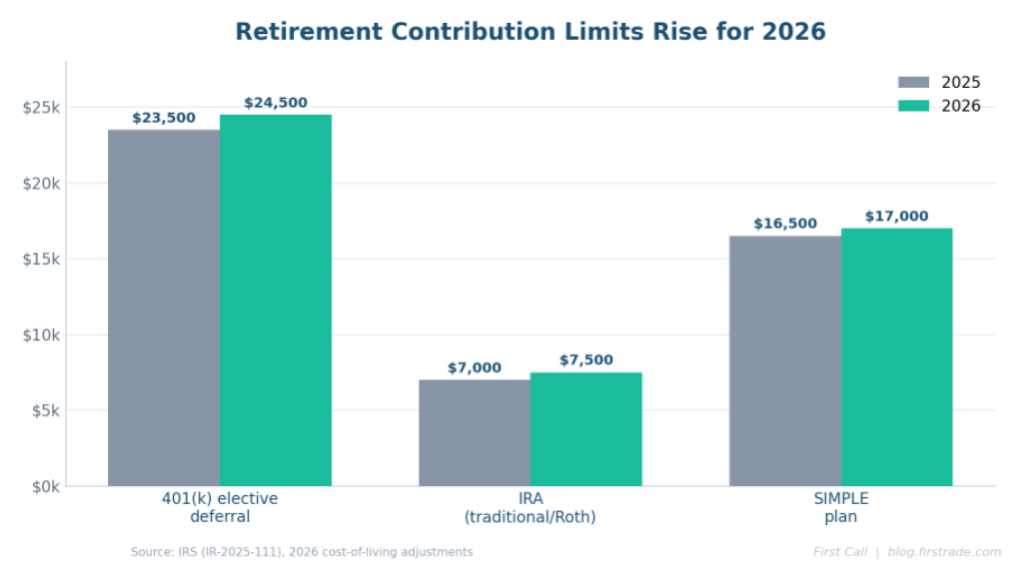
Contribution ceilings rose across the major account types for 2026. Source: IRS (IR-2025-111).
What the Higher Limits Mean for You
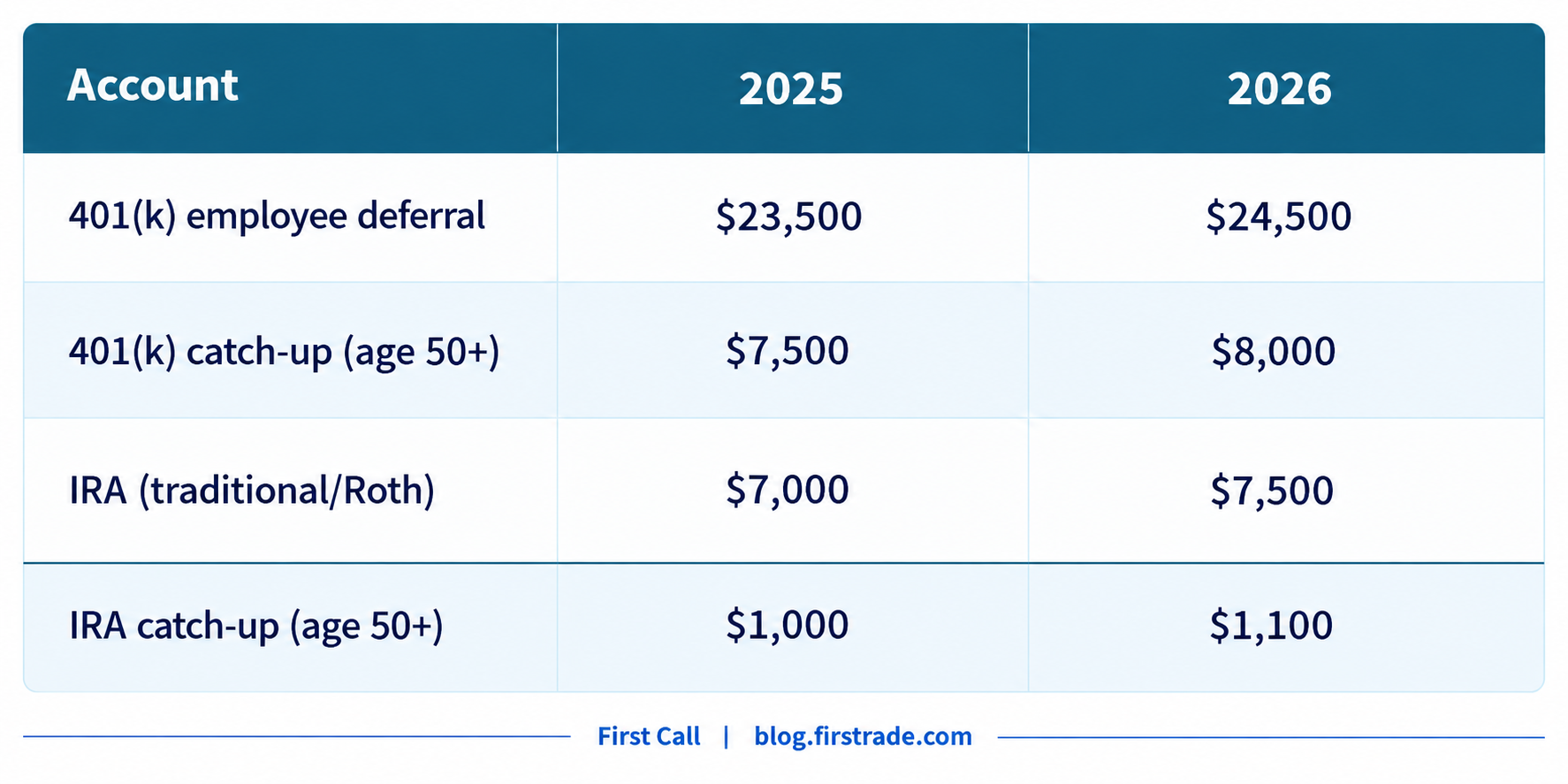
If you are 50 or older, the change is bigger, because catch-up contributions stack on top. In 2026 the 401(k) catch-up is $8,000, bringing the total to $32,500, and savers aged 60 to 63 can use a larger $11,250 catch-up where the plan allows it. The chart shows how much can go into a 401(k) at different ages this year. The difference between the two account types is mostly about timing: a traditional contribution can lower this year's taxable income, while a Roth is funded with after-tax dollars so that qualified withdrawals in retirement can come out tax-free. Whether a traditional or Roth account fits your situation depends on your income and tax picture, which is a question for a tax professional or your broker; Firstrade offers 24/7 customer service.2
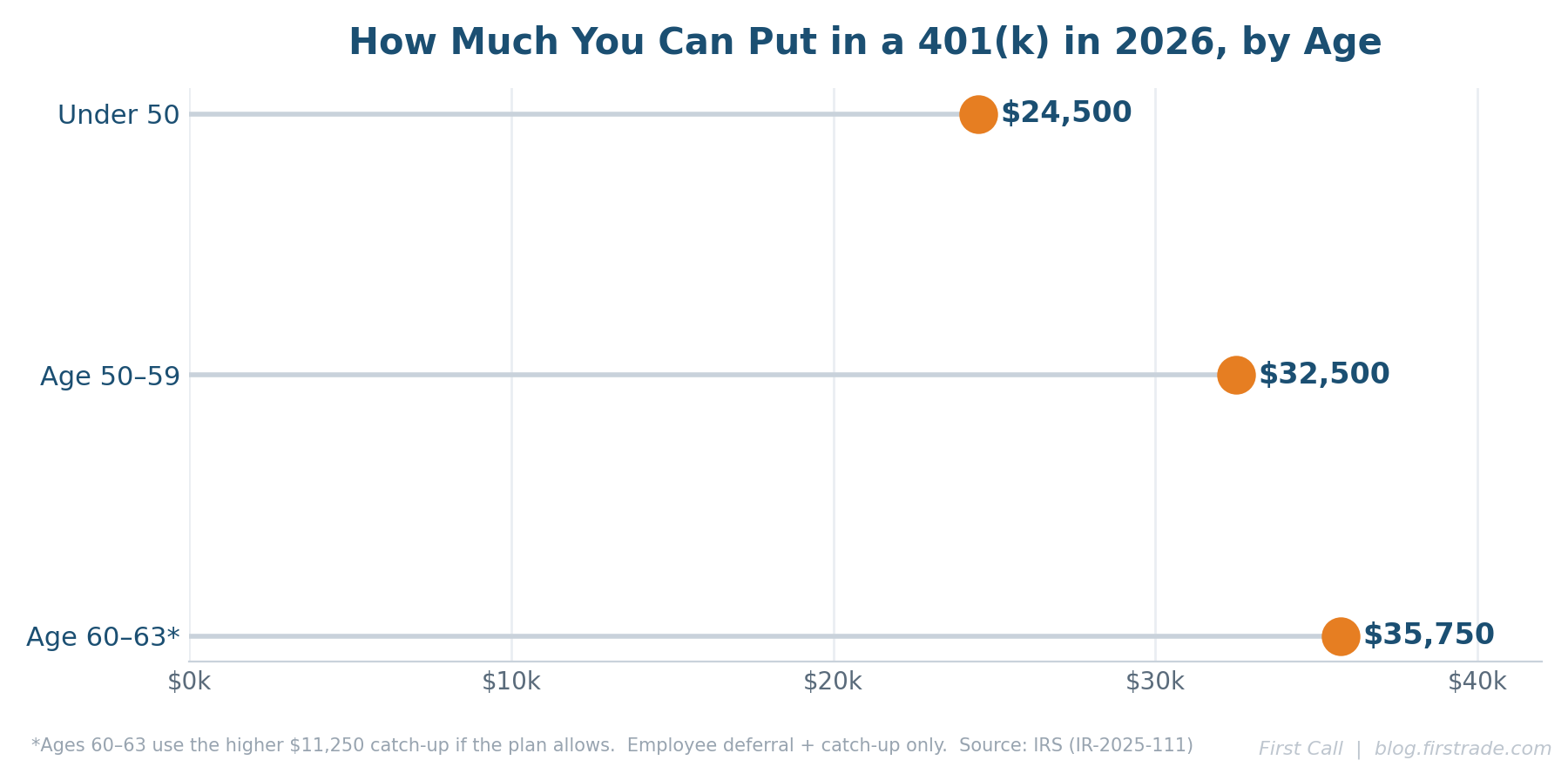
2026 employee deferral plus catch-up, by age band. Source: IRS (IR-2025-111).
Roth IRA eligibility also phases out by income. For 2026 the phase-out range is $153,000 to $168,000 for single filers and heads of household, and $242,000 to $252,000 for married couples filing jointly, so higher earners may be able to contribute only a reduced amount, or may need to look at another route with a tax professional. Note too that your IRA limit is entirely separate from your workplace plan: being in a 401(k) does not use up any of your $7,500 IRA room.
How to Put the New Limits to Work in Four Steps
The higher ceilings only help if you actually adjust what you are putting in. This takes one sitting with your pay stub and account statement open. Most payroll systems let you change your contribution percentage yourself, and the change usually takes effect within a pay cycle or two.
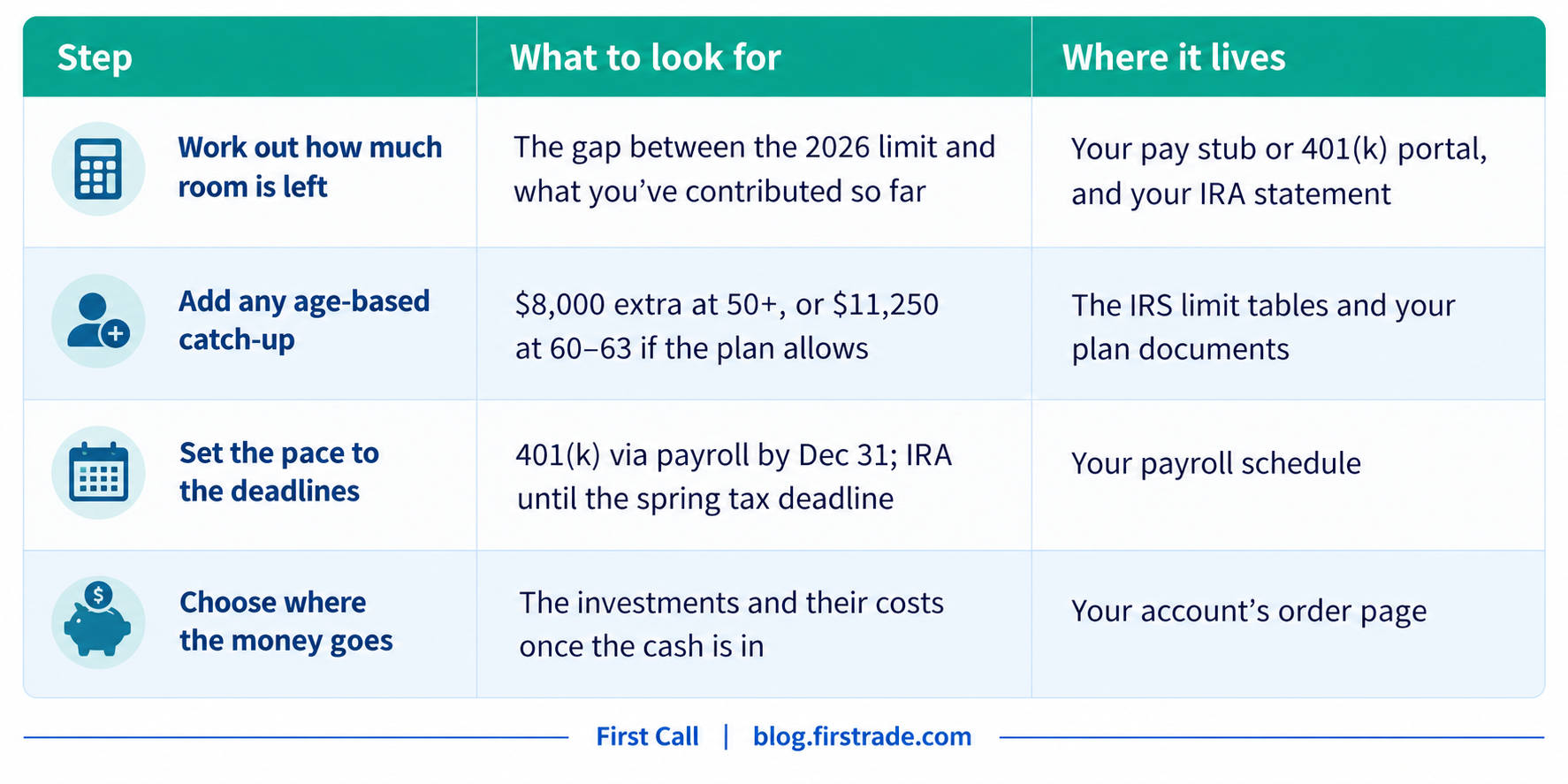
Spreading a lump-sum top-up over the remaining paychecks of the year is one way to avoid straining any single month. And once the cash is in, topping up an IRA across a few funds is only worth doing cheaply; Firstrade's $0 commission on U.S. stock, ETF, mutual fund and options trades keeps each contribution from leaking into costs.
Common Questions
When is the deadline to contribute for 2026?
Workplace plan contributions like a 401(k) generally have to be made through payroll by December 31, 2026. IRA contributions for the year can usually be made up until the federal tax filing deadline the following spring, which buys a little extra time. If cash flow is tight before year-end, a common rule of thumb is to prioritize the 401(k) up to any employer match first, since a match is money you forfeit if you do not contribute enough to earn it.
Can I contribute to both a 401(k) and an IRA?
In most cases, yes. Being in a workplace plan does not by itself stop you from contributing to an IRA, though your income and filing status can affect how much of a traditional IRA contribution is deductible, or how much you can put in a Roth. Where both are available, many savers use the workplace plan for its higher limit and the IRA for its wider choice of investments.
Deciding how much more to contribute takes an afternoon; acting on it takes an account. A Firstrade account can be opened online, and funding it carries $0 commission on online U.S. stock, ETF, mutual fund and options trades, with no options contract fees. If a question comes up before the deadline, 24/7 customer service is there.
This article is for educational and informational purposes only and does not constitute investment, tax, or financial advice. Contribution limits and tax rules are set by the IRS and may change; consult a qualified tax professional about your situation. Firstrade does not provide tax advice. Securities products and services are offered through Firstrade Securities Inc., Member FINRA/SIPC.