The Federal Reserve's latest interest rate decision arrives at a moment when patience, not action, has become the defining theme of U.S. monetary policy. After cutting rates by a cumulative 175 basis points between September 2024 and December 2025, the Federal Open Market Committee (FOMC) has now held its benchmark rate steady for four consecutive meetings, most recently confirming a target range of 3.50% to 3.75% at its June 17, 2026 meeting. For retail investors, understanding why the Fed is pausing - and what that pause means for stocks, bonds, and cash - matters more than trying to predict the committee's next move.
Where Rates Stand Going Into the July Meeting
The FOMC's next meeting is scheduled for July 28-29, 2026. Market pricing tied to CME FedWatch data has put the odds of another hold near 78%, with roughly 22% odds assigned to a rate move. That marks a notable shift in tone from the rapid cuts of late 2024, when the Fed eased policy in 25-basis-point increments at a brisk pace. Federal Reserve Chair Kevin Warsh, who took the helm of the central bank earlier this year, has signaled a more cautious, inflation-focused approach than his predecessor - a shift already visible in the Fed's own economic projections.
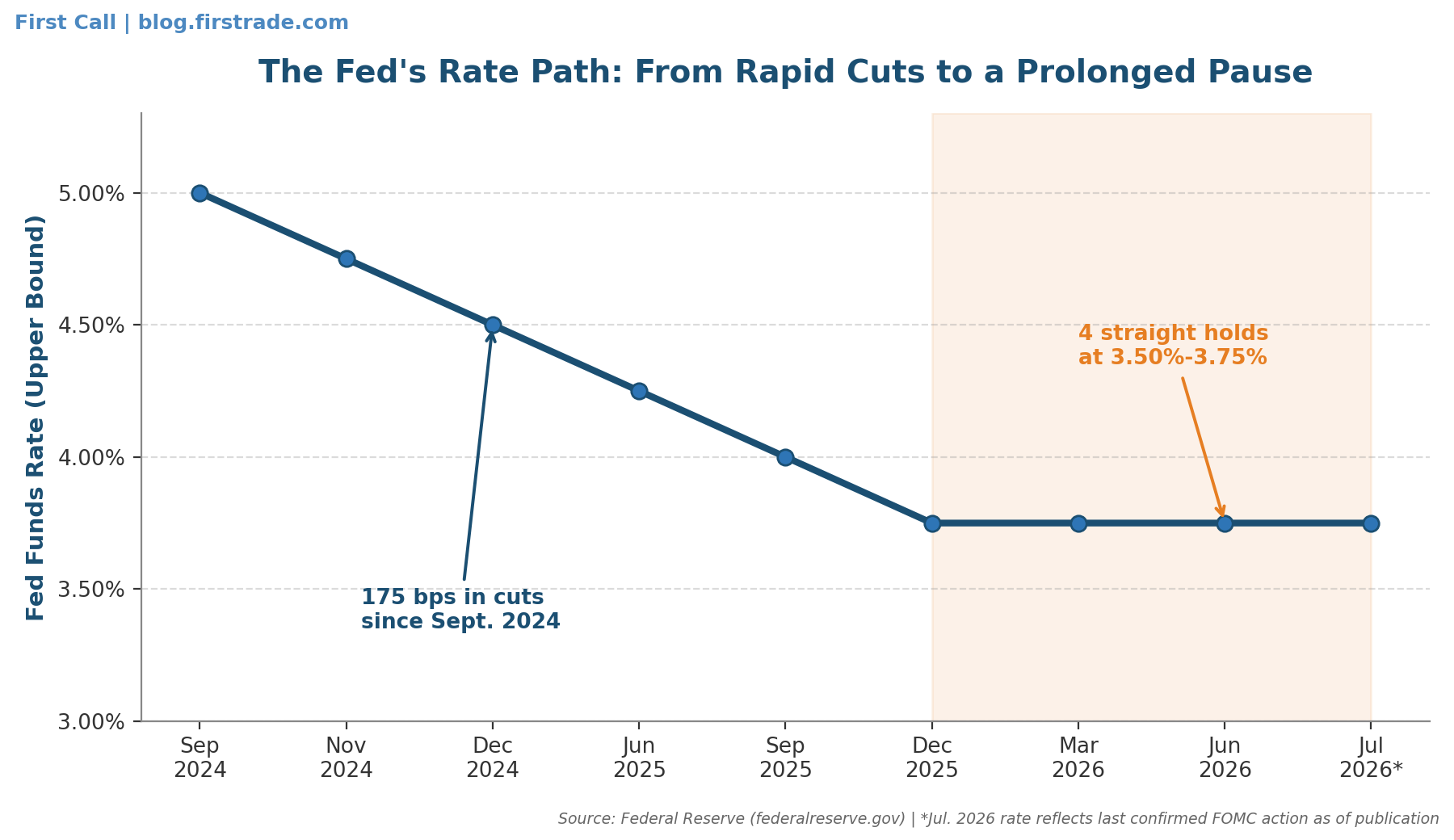
The Fed's benchmark rate has held at 3.50%-3.75% for four straight meetings after a rapid string of cuts. Source: Federal Reserve (federalreserve.gov).
A Higher Inflation Forecast Changes the Calculus
Perhaps the most consequential detail in recent Fed communications is the upward revision to the 2026 inflation outlook. The Fed's preferred inflation gauge, core PCE, is now projected at 3.6% for 2026, up sharply from an earlier estimate of 2.7%. That's a meaningful gap versus the Fed's 2% long-run target, and it helps explain why policymakers appear in no rush to resume cutting rates even as growth data has softened in some areas. Energy prices, which moved higher following the end of the ceasefire between the U.S. and Iran, are one factor analysts point to as adding upward pressure on headline inflation readings.
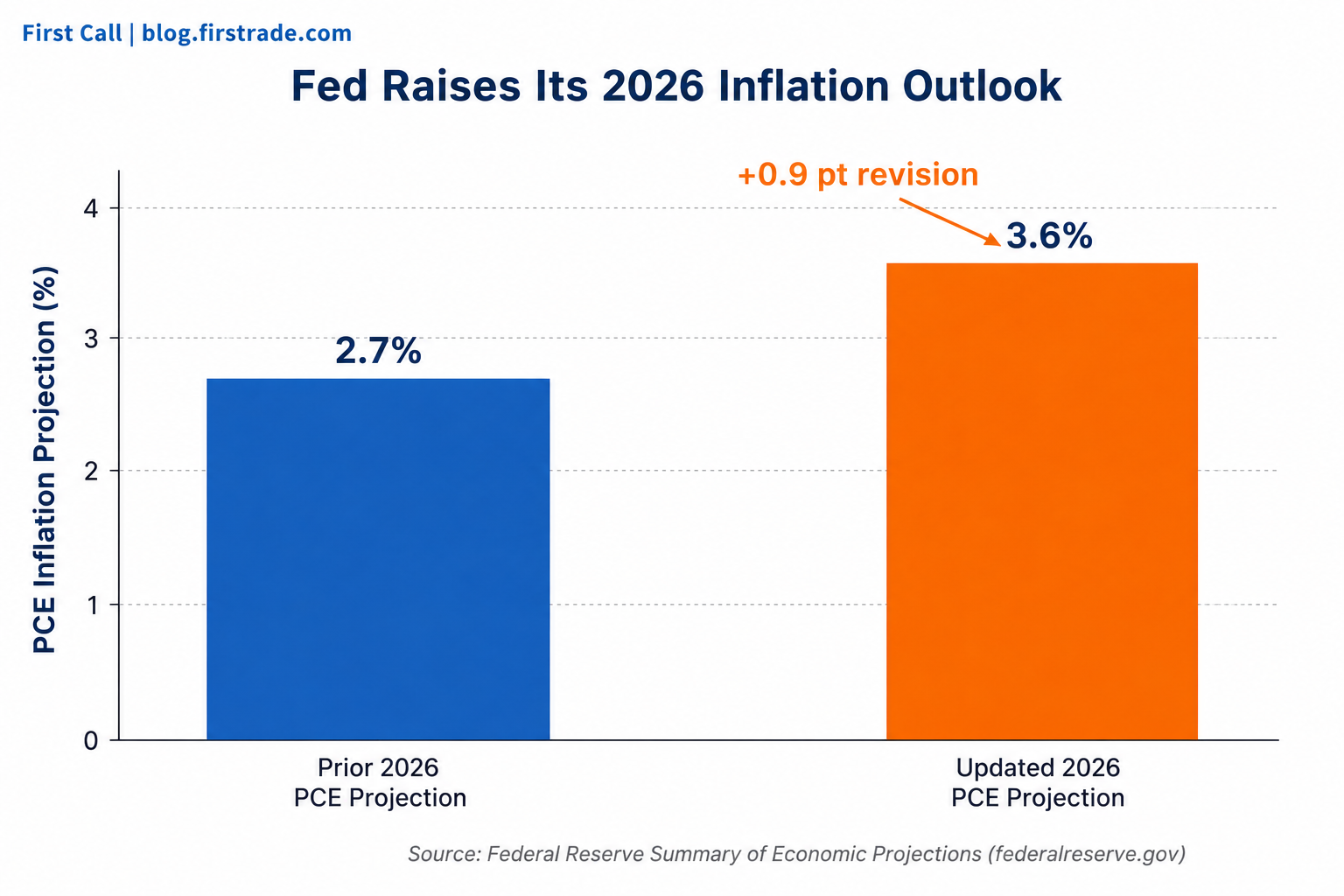
The Fed's 2026 core PCE inflation projection was revised up nearly a full percentage point. Source: Federal Reserve Summary of Economic Projections.
How Rate Pauses Typically Affect Different Asset Classes
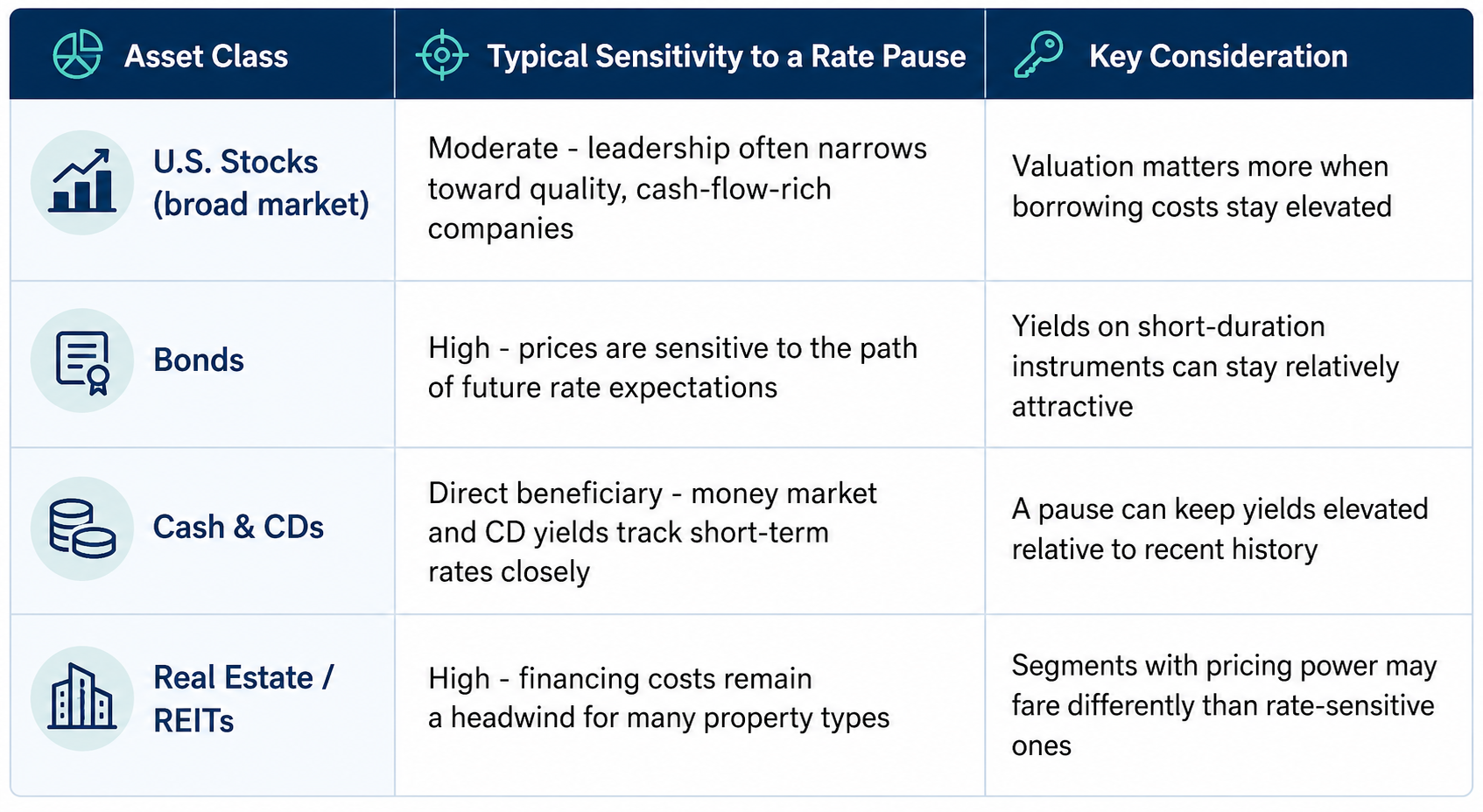
Extended rate pauses don't move every corner of the market the same way. The table below offers a general, educational comparison of how different asset classes have historically responded to a "higher for longer" rate environment - not a prediction of future performance.
FAQ: Common Questions About the Fed and Your Investments
What does a "rate pause" mean for my portfolio?
A pause simply means the Fed is leaving its benchmark rate unchanged rather than cutting or hiking it. That doesn't guarantee stability in stock or bond prices, which react to a wide range of factors including corporate earnings, economic data, and shifting expectations for future meetings.
Should I move money into cash while rates stay elevated?
That depends entirely on individual goals, time horizon, and risk tolerance - questions best explored with a financial or tax professional. What's broadly true is that money market funds and CDs have offered relatively competitive yields during this pause, which is one reason some investors keep a portion of savings in cash-equivalent instruments.
When might the Fed cut rates again?
No one, including the Fed itself, can say with certainty. Market-implied probabilities shift from meeting to meeting based on incoming inflation, employment, and growth data, and the Fed has been explicit that future decisions will remain data-dependent.
Building a Rate-Resilient Portfolio
Rather than trying to time the Fed's next move, many long-term investors focus on diversification across asset classes, sectors, and time horizons - an approach that doesn't depend on guessing correctly when policy will shift. Reviewing asset allocation periodically, rebalancing when it drifts from target, and keeping trading costs low are practical steps that apply in nearly any rate environment, whether the Fed is cutting, holding, or eventually hiking again.
It's also worth remembering that Fed policy is only one input among many. Corporate earnings growth, valuation levels, and broader economic conditions all interact with interest rates to shape market outcomes, which is why a single data point - even one as closely watched as an FOMC decision - rarely tells the whole story.
A Practical Next Step
Putting these ideas into practice starts with a platform that keeps costs out of the way while markets digest each Fed decision. Firstrade offers commission-free trading on U.S. stocks, ETFs, mutual funds, and options - with no options contract fees - and 24/7 customer service whenever questions about the rate environment come up.
This article is for educational and informational purposes only and does not constitute investment, legal, or tax advice. It is not a recommendation to buy or sell any security. Investing involves risk, including possible loss of principal. Firstrade Securities Inc. is a member of FINRA and SIPC.