The Complete Guide to the PDT Rule Elimination: Everything Investors Need to Know Before June 4

On April 14, 2026, the Securities and Exchange Commission approved FINRA’s comprehensive overhaul of Rule 4210, officially eliminating the Pattern Day Trader (PDT) designation and the $25,000 minimum equity requirement that has restricted retail day traders for over two decades. The new intraday margin framework takes effect on June 4, 2026, replacing arbitrary trade-counting metrics with a risk-sensitive system that reflects real-time market exposure. This is not a minor tweak — it is a fundamental reimagining of how active trading is governed in the United States, and every investor with a margin account needs to understand what is changing.
What Exactly Is Being Eliminated?
Under the old rules, any trader who executed four or more day trades within five business days in a margin account was designated a "pattern day trader" and required to maintain at least $25,000 in account equity. Fall below that threshold, and your account would be frozen for day trading until you deposited enough to restore the balance. The rule, implemented in September 2001 in the aftermath of the dot-com bubble, was intended to protect inexperienced traders from steep losses — including those from commissions, which were significantly higher at the time.
FINRA’s own board of governors acknowledged that the rule had become outdated. In an era of zero-commission trading and advanced real-time risk monitoring systems, the $25,000 barrier no longer served its original purpose. Instead, it often forced retail investors to hold positions overnight to avoid triggering PDT status — ironically increasing their risk exposure rather than reducing it.
What Is the New Intraday Margin Framework?
The replacement system centers on three technical concepts that every active trader should understand:
Intraday Margin Level (IML)
This is the running balance of your account’s maintenance margin excess or deficit throughout the trading day. Think of it as a real-time measurement of how much additional risk your account can absorb. It can be calculated as the amount of cash you could withdraw while still meeting margin requirements — or, if negative, the additional cash you would need to deposit to satisfy those requirements.
IML-Reducing Transaction
Any trade or action that decreases your IML. This includes buying securities, selling options short, the expiration of long options (including zero-day-to-expiration, or 0DTE, options), and withdrawing cash or securities from your account.
Intraday Margin Deficit (IMD)
The largest negative IML recorded during the trading day following an IML-reducing transaction. Critically, an IMD is not triggered by mark-to-market losses alone — if your IML goes negative solely because the market moved against your existing positions, that does not create an IMD. Only customer-initiated activity that reduces margin excess can trigger a deficit.
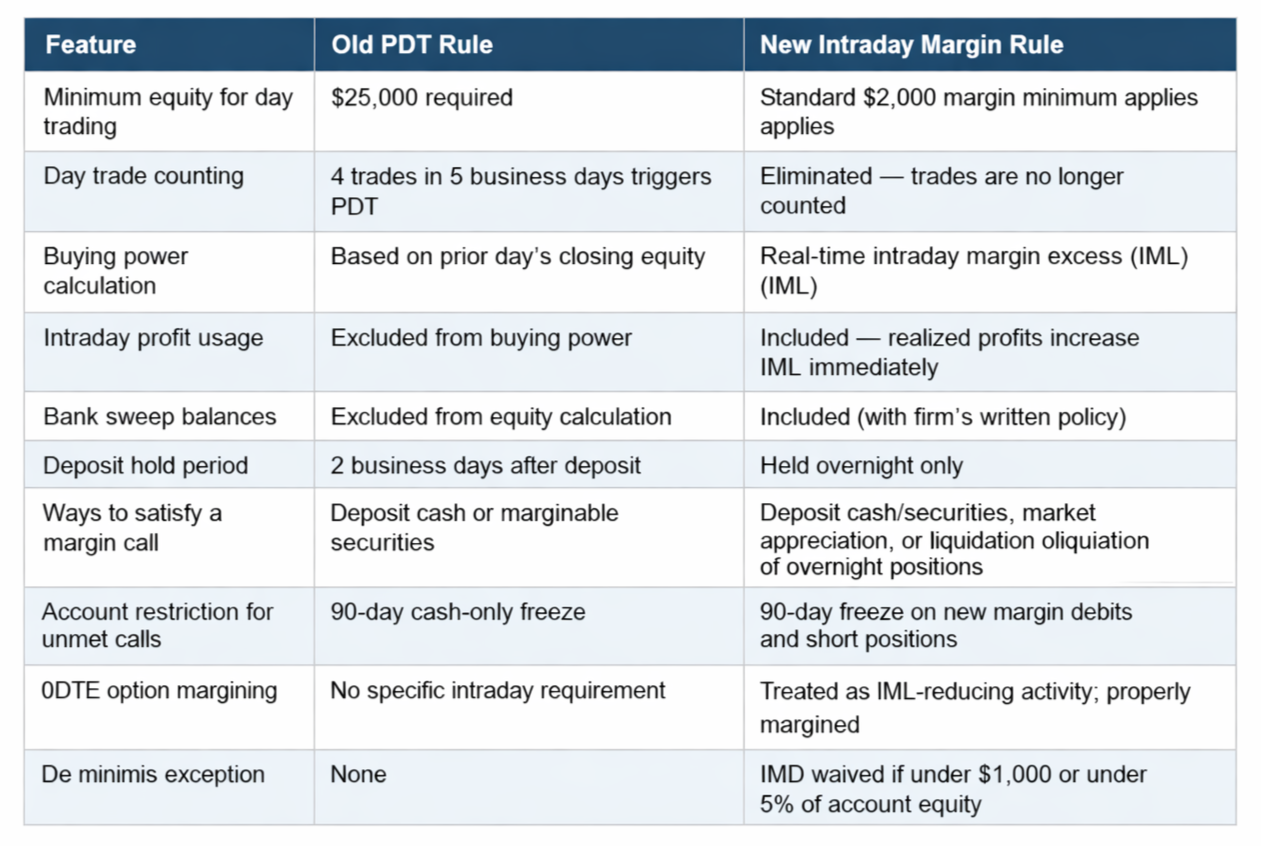
Old Rules vs. New Rules: A Side-by-Side Comparison
What Does This Mean for Your Day-to-Day Trading?
The practical impact depends on your account size and trading style. Here are the key changes that will affect how you trade starting June 4:
No More Trade Counting
Brokerages will stop tracking the number of day trades you make. You can trade in and out of positions throughout the day without worrying about triggering a PDT designation or facing account restrictions based on trading frequency. The concept of "day trade buying power" as a separate metric is going away.
Real-Time Buying Power
Under the old rules, your day-trading buying power was calculated based on your account’s equity at the previous day’s close. Under the new framework, your buying power updates dynamically throughout the day based on your current positions, unrealized gains and losses, and available margin. Realized profits from closed trades are immediately reflected in your available buying power, allowing you to redeploy capital within the same trading session.
Bank Sweep Balances Count
If your brokerage sweeps idle cash into an FDIC-insured bank program, those balances can now be included in your intraday equity calculation. Previously, swept funds were excluded from day-trading buying power, which could create unexpected margin shortfalls.
Faster Deposit Availability
Under the old rules, funds deposited to satisfy a day-trading margin call had to be held in the account for two full business days. The new framework requires deposits to be held overnight only — meaning capital is available for trading more quickly.
What Happens If You Get an Intraday Margin Deficit?
Under the new system, if your trading activity pushes your IML into negative territory, you have an intraday margin deficit (IMD) that needs to be resolved. Here is the timeline:
Prompt satisfaction: You are expected to resolve the deficit as quickly as possible through deposits, market appreciation, or liquidation of positions.
5-day window: If the IMD is not satisfied within five business days, your brokerage must take a capital charge.
90-day restriction: If you develop a pattern of failing to meet IMDs within five days, your account may face a 90-day restriction on creating new margin debits or short positions. However, you can still close existing positions during this period.
De minimis exception: Restrictions are waived for IMDs that are less than $1,000 or less than 5% of your account equity, preventing minor shortfalls from triggering significant consequences.
How Will Brokerages Implement the New Rules?
FINRA has given brokerages flexibility in how they implement the new framework. Firms have two choices: monitor margin in real time and potentially block trades that would create intraday margin deficits, or perform a single end-of-day calculation and address any deficits retroactively.
The June 4, 2026 effective date is the starting point, but firms have an 18-month transition window through October 20, 2027 to fully update their systems. During this transition period, brokerages may apply either the old PDT rules or the new intraday margin rules as they complete their technology upgrades. Some firms have already announced they will implement on or near day one, while others may take longer to transition.
What About Portfolio Margin Accounts?
The new rules include specific provisions for Portfolio Margin (PM) accounts. PM accounts with $5 million or more in equity are exempt from the intraday margin requirements, provided their brokerage has the technology to monitor intraday risk. PM accounts with less than $5 million must maintain intraday margin that is substantially similar to the margin required for end-of-day positions.
What Are the Risks Traders Should Prepare For?
While the elimination of the PDT rule removes a significant barrier, it also introduces new responsibilities that traders need to take seriously:
Real-time margin complexity: The new IML system is more dynamic and nuanced than the old binary $25,000 threshold. Traders need to monitor their intraday margin levels actively, as rapid market moves combined with trading activity can quickly erode available margin.
Leverage risk for smaller accounts: With the $25,000 minimum gone, traders with smaller accounts can now day trade on margin. This access to leverage without the old guardrail means potential losses can exceed the capital in your account.
0DTE options exposure: The new framework properly margins zero-day-to-expiration options for the first time. Traders accustomed to using 0DTE strategies should understand that option expirations are now classified as IML-reducing transactions, which could affect their margin levels.
Volatility in high-retail-ownership stocks: As more traders gain access to day trading, securities with concentrated retail ownership may experience increased intraday volatility from the flow of new participants entering and exiting positions.
How Should You Prepare Before June 4?
If you are considering day trading once the new rules take effect, start preparing now:
Contact your brokerage: Ask when they plan to implement the new framework and whether they will use real-time monitoring or end-of-day calculation. Understand how your buying power will be displayed and updated.
Learn how IML works: Familiarize yourself with the concepts of intraday margin level, IML-reducing transactions, and intraday margin deficits. These will replace the old day-trade-counting system.
Review your risk management: Develop clear rules for position sizing, stop-loss levels, and maximum daily loss limits before you begin day trading. Access to day trading is not the same as readiness for day trading.
Start small: Consider beginning with smaller position sizes to get comfortable with the new intraday margin mechanics before scaling up your trading activity.
Understand margin mechanics: If you are new to margin trading, review your brokerage’s margin disclosure statement and make sure you understand how margin calls work, how interest is charged, and the risk of losing more than your initial deposit.
The Bottom Line
The elimination of the Pattern Day Trader rule is the most significant regulatory change for retail traders in a generation. By replacing the arbitrary $25,000 threshold and trade-counting system with a risk-based intraday margin framework, FINRA has modernized the rules to reflect how markets and technology actually work in 2026. For traders who have been waiting for this change, June 4 represents a genuine opportunity — but one that demands preparation, education, and disciplined risk management. The barrier to entry is lower, but the stakes of trading with leverage remain just as high.
If you have any questions about how these changes may affect your account, or need any assistance navigating the new intraday margin framework, Firstrade provides 24/7 client service to help you every step of the way.
To learn more, please visit our PDT Rule Change Help Center or review FINRA Regulatory Notice 26-10.
Disclaimer: This article is for educational and informational purposes only and does not constitute investment advice. Investing involves risk, including the possible loss of principal. Past performance does not guarantee future results. Margin trading is not suitable for all investors, and you could lose more than your initial investment. Before using margin, carefully assess your risk tolerance and financial situation. Consult a qualified financial advisor before making any investment decisions. Firstrade Securities Inc. is a member of FINRA/SIPC.