A Record $180B ETF Month: How to Check What Your ETF Actually Holds in Four Steps

U.S.-listed ETFs took in about $180 billion in August alone, roughly 3.8 times the historical monthly average, according to State Street data reported by InvestmentNews. Year-to-date inflows are above $1.4 trillion, and State Street projects $2.3 trillion for 2026, against the 2025 record of $1.52 trillion. For anyone who owns an ETF, the question that could matters is smaller than the headline: what is actually inside the fund, and does it overlap with everything else in the account?
What the August ETF Flow Numbers Show
The money did not move evenly. Equity ETFs took in more than $100 billion for a fifth straight month, bond ETFs added $55 billion, and active ETFs drew $62 billion. Those categories overlap, since an active fund can hold stocks or bonds. Broad developed markets outside the U.S. added $14 billion, and emerging markets added $6 billion, which brought their year-to-date total to $50 billion, a record. U.S.-focused ETFs hold 79% of total ETF assets but took only 65% of year-to-date equity flows.
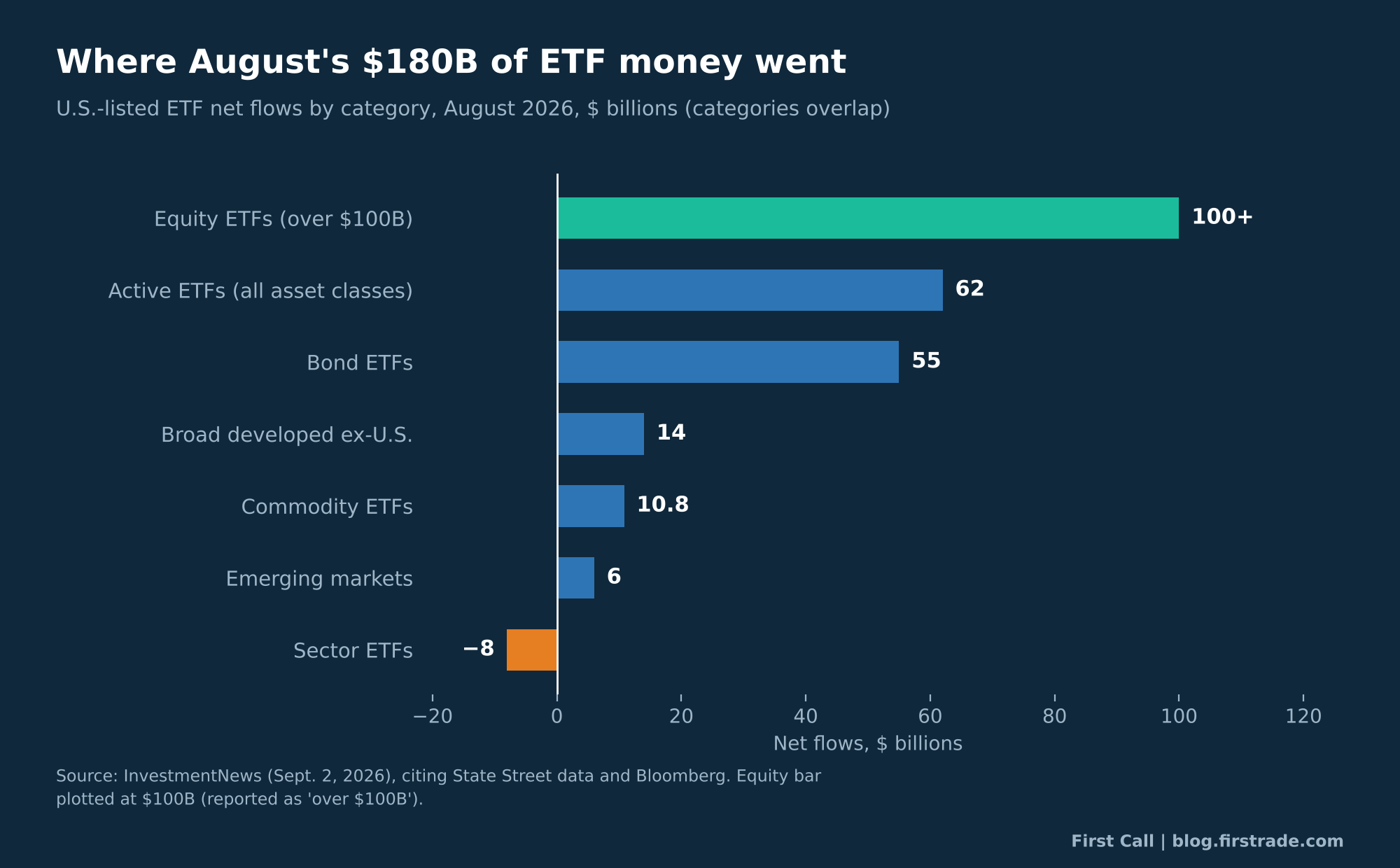
Chart 1: U.S.-listed ETF net flows by category, August 2026. Source: InvestmentNews, citing State Street data and Bloomberg.
Inside the stock market, money was also changing places. Sector ETFs as a group lost $8 billion in August. Technology funds saw $6.1 billion of outflows even though the sector rose nearly 6% that month, financials saw $4.9 billion of outflows, and health care took in $2.2 billion, according to the same InvestmentNews report, citing State Street data (see Chart 2).
What It Means for Your Own Portfolio
Money moving between sectors does not change what your own fund holds. A fund's name describes its theme, not necessarily its contents. Two ETFs with different labels can hold many of the same large companies, and a broad index fund can lean heavily on a few of them.
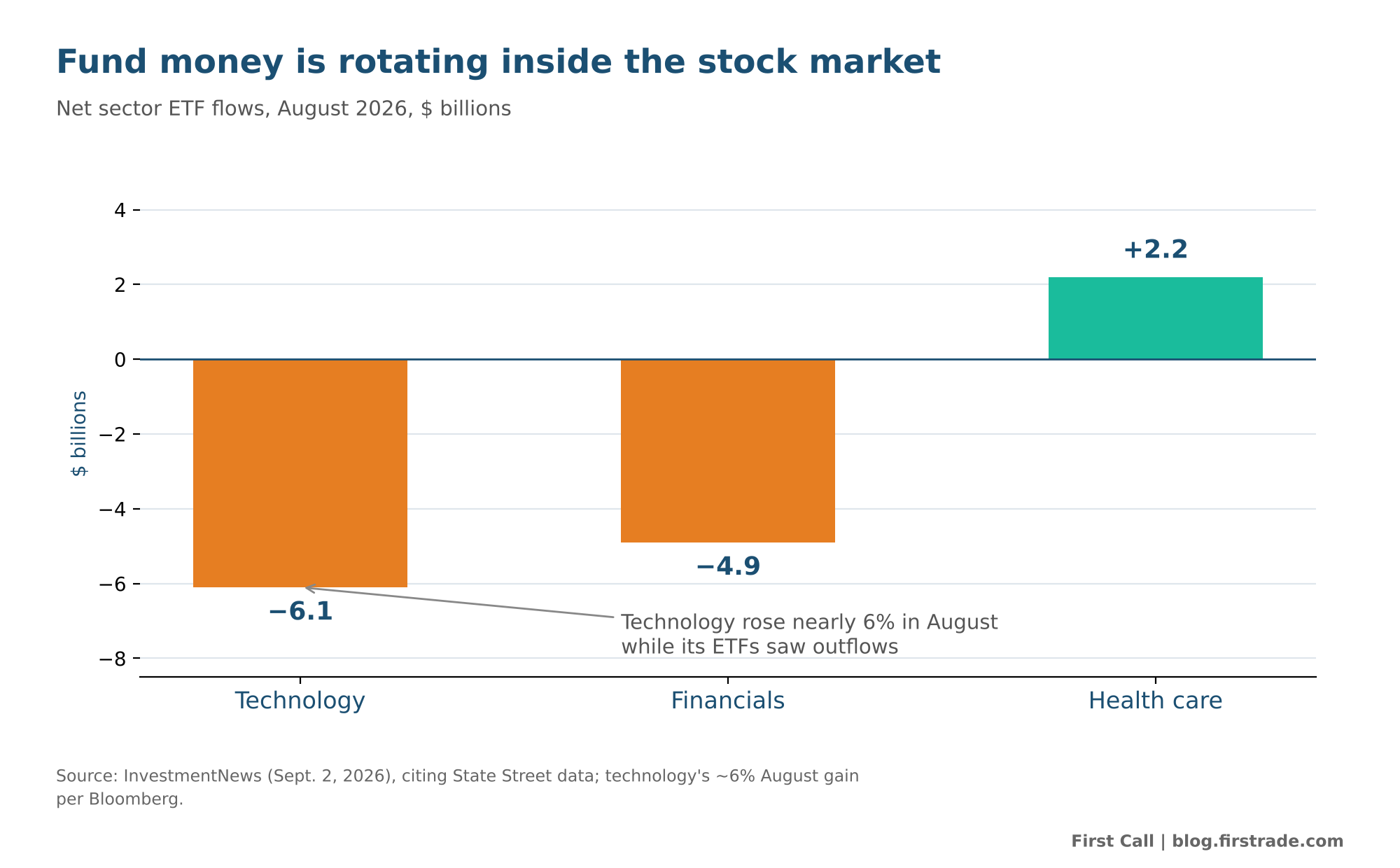
Chart 2: Net sector ETF flows, August 2026. Source: InvestmentNews, citing State Street data; technology's August gain per Bloomberg.
The earnings data in the same report shows why this is worth checking. S&P 500 second-quarter earnings grew 52%, the fastest pace since 2021, while the "other 493" companies grew 32%, according to FactSet and Bloomberg figures cited by InvestmentNews. When a handful of companies carries that much of an index's results, owning several index funds can mean owning the same few companies several times over. Every ETF publishes its top holdings, sector weights and expense ratio in its fact sheet, and the expense ratio also appears in the prospectus, so the answer is a lookup, not a guess. If a figure is hard to match to what you own, a broker can help with the question, and Firstrade's customer service runs 24/7.
What to Actually Do About It: Four Steps
None of this requires selling anything. It is a review of public documents, and it fits in an afternoon.
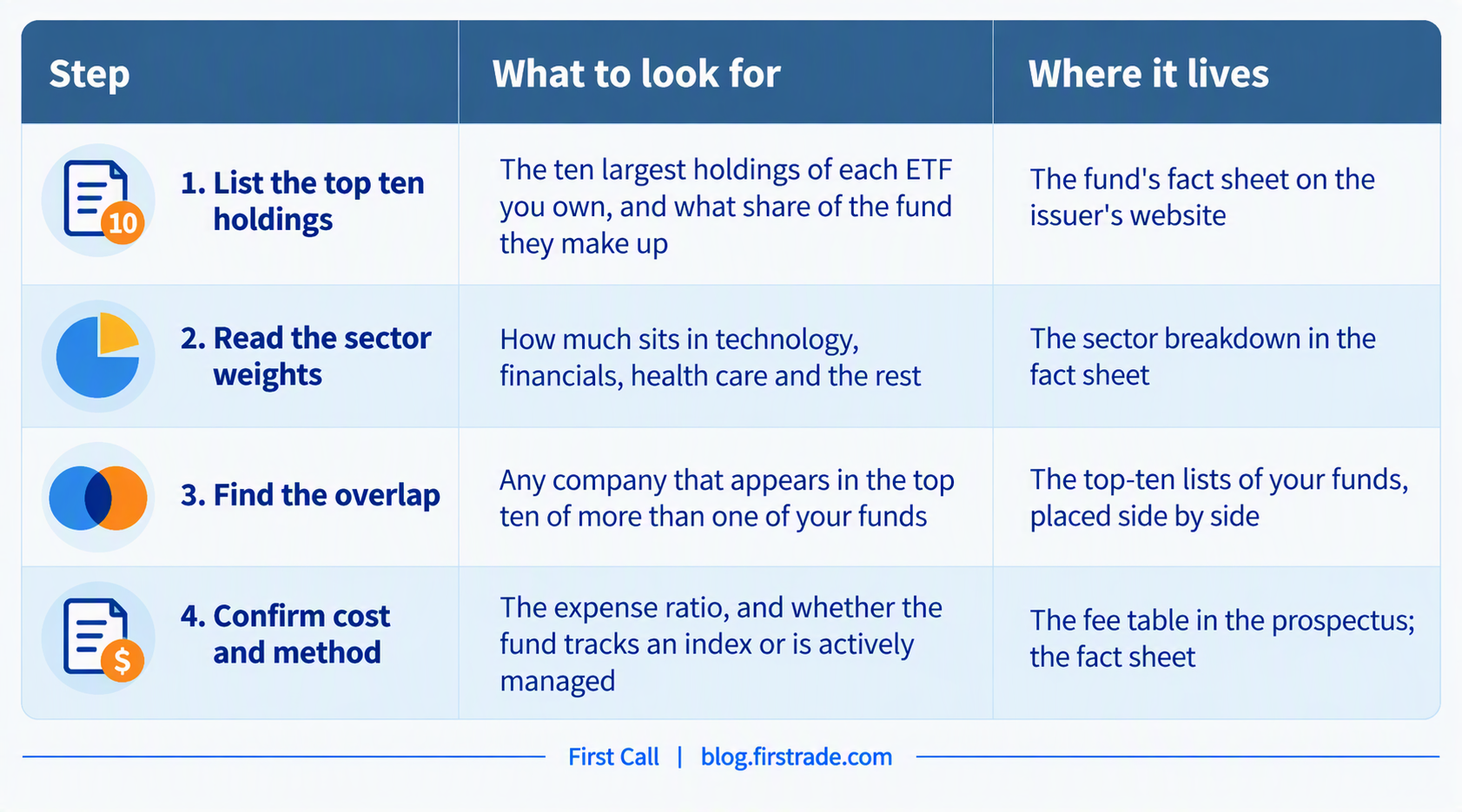
Step 3 is the easiest to skip. Take the top-ten lists of two funds that sound different, such as a broad index fund and a technology fund, and look for names that appear on both. For example, a company that makes up 7% of one fund and 5% of another is 12% of the combined holding, and that is before counting any shares owned directly.
Add up the percentages of any company that shows up in more than one fund, and the total is your real exposure to it. Sector weights are the slowest step to gather by hand, and Firstrade's Sectors & Industries research tool charts performance data by drilling down from sectors to individual companies, all in one page.
If the check turns up heavy overlap, what to do about it is a personal decision. Nothing here is a recommendation to buy or sell any fund.
FAQ
Does a record month of ETF inflows tell me where the market is going?
No. Flows record where money went, not where it goes next. In the same report, technology stocks rose nearly 6% in August while technology ETFs saw outflows.
Where do I find an ETF's top holdings?
In the fund's fact sheet on the issuer's website. Holdings change over time, so check the date printed on the document before relying on the numbers.
What does overlap mean?
It means the same company sits inside more than one fund you own. Each fund may hold only a small slice, but the slices add up to more than any one fact sheet suggests.
The Bottom Line
Checking top holdings, sector weights and overlap is an afternoon's work, and it uses documents anyone can download. If the review leads to adjustments, a Firstrade account can be opened online, with $0 commission on online U.S. stock, ETF, mutual fund and options trades and no options contract fees. 24/7 customer service is there if a question comes up along the way.
This article is for informational and educational purposes only and does not constitute investment, tax or legal advice, or a recommendation to buy or sell any security. Investing involves risk, including possible loss of principal. Rules, rates and thresholds change, and individual circumstances differ. Firstrade Securities Inc. is a member of FINRA and SIPC. For commission and fee details, see Firstrade's pricing page at firstrade.com/trading/pricing.