Big Tech's $725 Billion AI Spending Surge: What It Means for Your Portfolio
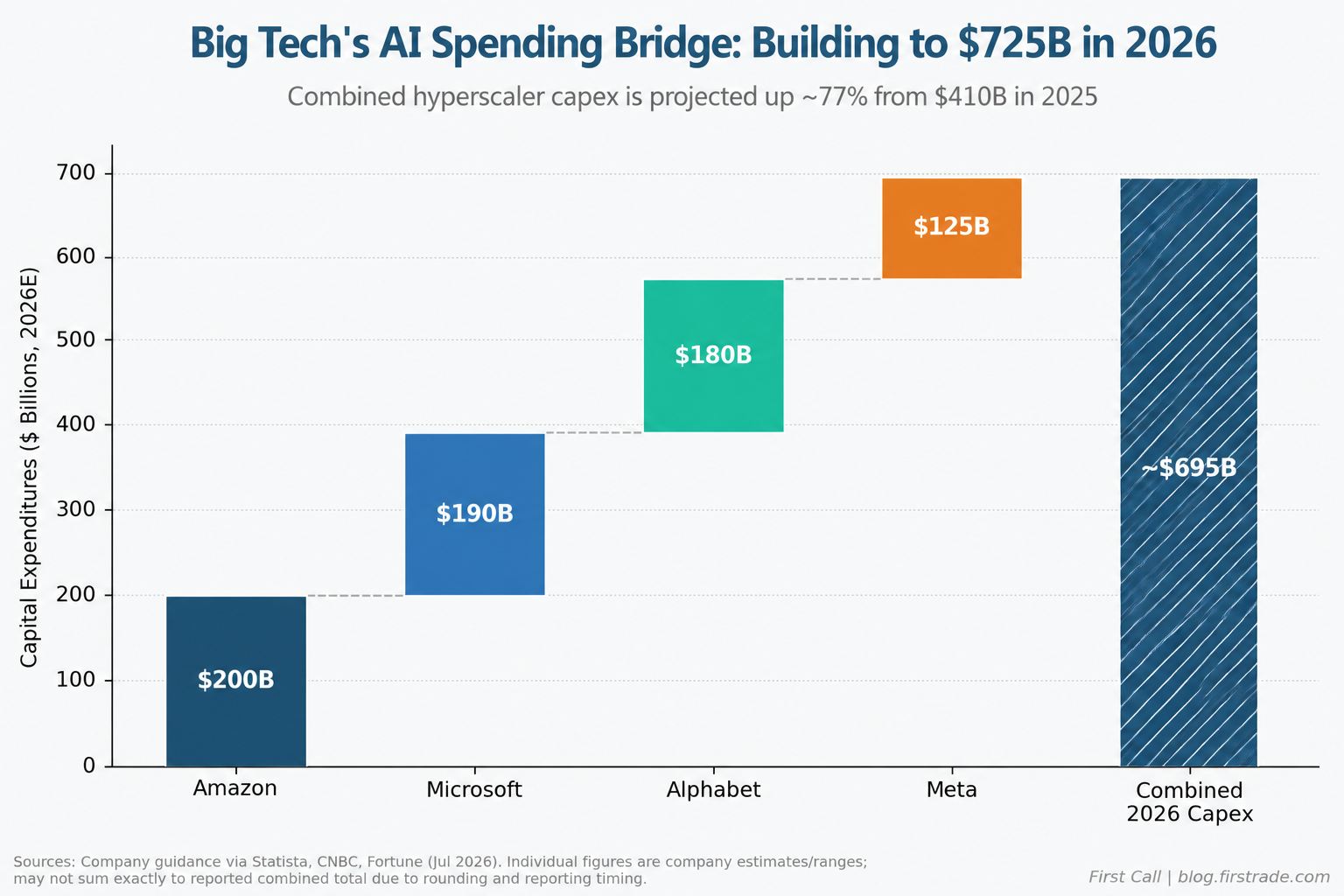
Big Tech's AI spending has reached a scale few investors could have imagined even two years ago. Amazon, Microsoft, Alphabet, and Meta are together on track to spend roughly $725 billion on capital expenditures in 2026 — up about 77% from an already record $410 billion in 2025, according to figures compiled by Statista and reported by CNBC and Fortune. With Amazon, Meta, and Microsoft all reporting quarterly earnings this week, the size and pace of this spending has become one of the most closely watched stories in the market. For retail investors, understanding what's driving this surge — and how markets are reacting to it — matters more than ever.
Why AI Capital Expenditures Are Exploding in 2026
The spending is almost entirely tied to AI infrastructure: graphics processing unit (GPU) clusters, custom silicon, and new data center construction. Three forces are pushing the numbers higher. First, training costs for frontier AI models continue to scale with the amount of computing power used. Second, demand for AI products already in the market — think Copilot, Gemini, Meta AI, and Alexa+ — is outpacing the capacity companies built just a year or two ago. Third, each hyperscaler is racing to build its own proprietary chips to reduce dependence on outside suppliers and lower the cost of running AI workloads over time.
How Much Is Each Hyperscaler Spending?
Company-level guidance gives a clearer picture of where the money is going. The table below reflects the most recent capital expenditure guidance for calendar year 2026, as reported across financial media this month.
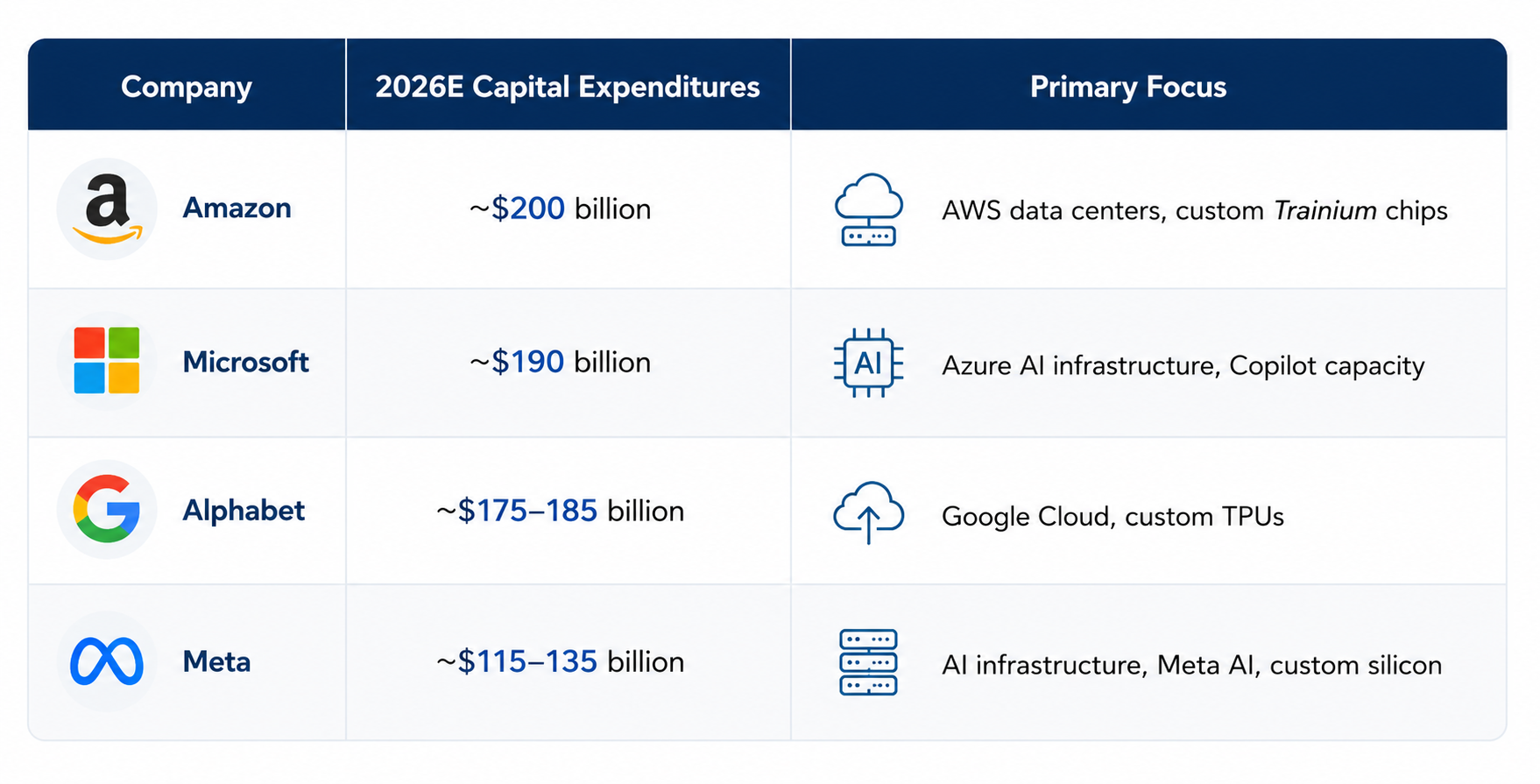
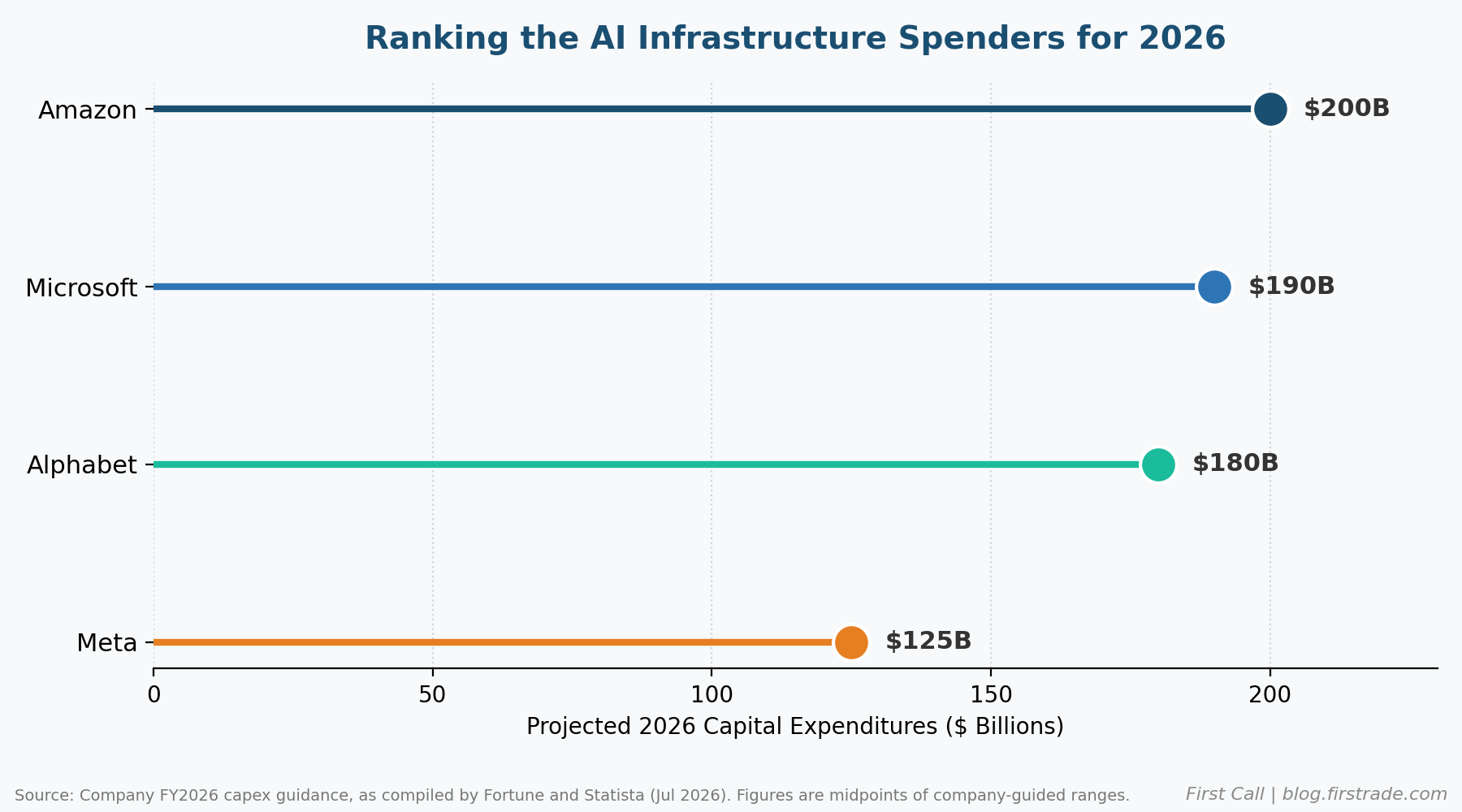
Combined, these four companies alone account for the bulk of the industry's projected $725 billion in AI-related capital spending this year.
FAQ: What Is Capital Expenditure (Capex) and Why Does It Matter to Investors?
Capital expenditure, or capex, refers to money a company spends to acquire, upgrade, or maintain physical assets like data centers, equipment, and infrastructure. Unlike operating expenses, capex is typically a long-term investment reflected on the cash flow statement rather than fully expensed right away. For investors, rising capex can signal confidence in future growth — but it also reduces free cash flow in the near term, which is why markets scrutinize these numbers closely during earnings season.
The Market's Reaction: Why Investors Are Nervous
Markets have responded unevenly to this spending wave. Alphabet shares fell more than 7% on a single trading day this week — their worst day in over a year — after the company raised its 2026 capex guidance to as much as $205 billion and reported that free cash flow turned negative for the first time since its 2004 initial public offering. Meta shares have dropped nearly 10% over a similar period as investors question the near-term payoff of its AI investments. At the same time, a widely followed weekly sentiment survey of individual investors showed bullish sentiment falling to its lowest level since September 2022, while a major semiconductor-sector ETF slid more than 4% on valuation concerns.
FAQ: Could This Be an AI Bubble?
It's a fair question, and reasonable analysts disagree. Optimists point to genuine, rapidly growing demand for AI compute and note that these companies are self-funding the buildout with substantial operating cash flow, unlike the debt-fueled infrastructure booms of prior tech cycles. Skeptics counter that capex is rising faster than proven revenue from AI products, and that a slowdown in AI adoption could leave companies with expensive, hard-to-repurpose data center capacity. Rather than picking a side, most financial professionals suggest investors focus on company fundamentals — free cash flow trends, revenue growth tied to AI products, and capital discipline — rather than headlines alone.
What This Means for Retail Investors
Diversification Over Concentration
Big Tech now represents an outsized share of major indexes like the S&P 500, meaning many investors already have significant AI-related exposure through broad index funds and ETFs, even without owning individual mega-cap stocks directly. This is a good moment to review portfolio concentration and confirm your sector weightings still match your risk tolerance and time horizon, rather than adding further concentrated bets on a handful of names.
Watching Free Cash Flow, Not Just Revenue
As capex rises, free cash flow becomes a more telling metric than revenue growth alone. Investors following this earnings cycle may want to pay attention to how each company frames its capex-to-revenue ratio and whether management provides a clear timeline for AI investments to generate returns.
Navigating a fast-moving earnings week like this one is easier with the right tools and a cost structure that doesn't get in the way of research and rebalancing. Firstrade offers commission-free trading on U.S. stocks, ETFs, mutual funds, and options — with no options contract fees — plus 24/7 customer service, so investors can stay focused on the fundamentals during high-volatility periods like this one.
This article is for educational and informational purposes only and does not constitute investment advice or a recommendation to buy or sell any security. Investing involves risk, including possible loss of principal. Firstrade Securities Inc. is a member of FINRA and SIPC.