S&P 500 Earnings Set to Grow Nearly 24% in Q3: How to Check What Your Fund Is Actually Concentrated In Before Banks Report on October 13

Q3 2026 earnings season is barely underway — Oracle and Adobe reported their fiscal-August quarters back on September 10, and Nike, Micron and Accenture follow this week — but the season really gets going, in one earnings tracker's words, when JPMorgan Chase opens big-bank reporting on Tuesday, October 13, with Bank of America following a day later on October 14. Analysts currently expect S&P 500 earnings to grow 23.9% year over year for the quarter (Zacks Investment Research, via FXStreet), which would mark the eighth straight quarter of double-digit growth for the index.
That number is worth pausing on — not because it will move much by the time the last report is in, but because it is not evenly spread. If you own a broad index fund or ETF, “the S&P 500” is not one story this earnings season. It is several very different ones, stacked inside a fund you may never have actually opened up to look at.
What Happened, and What It Is
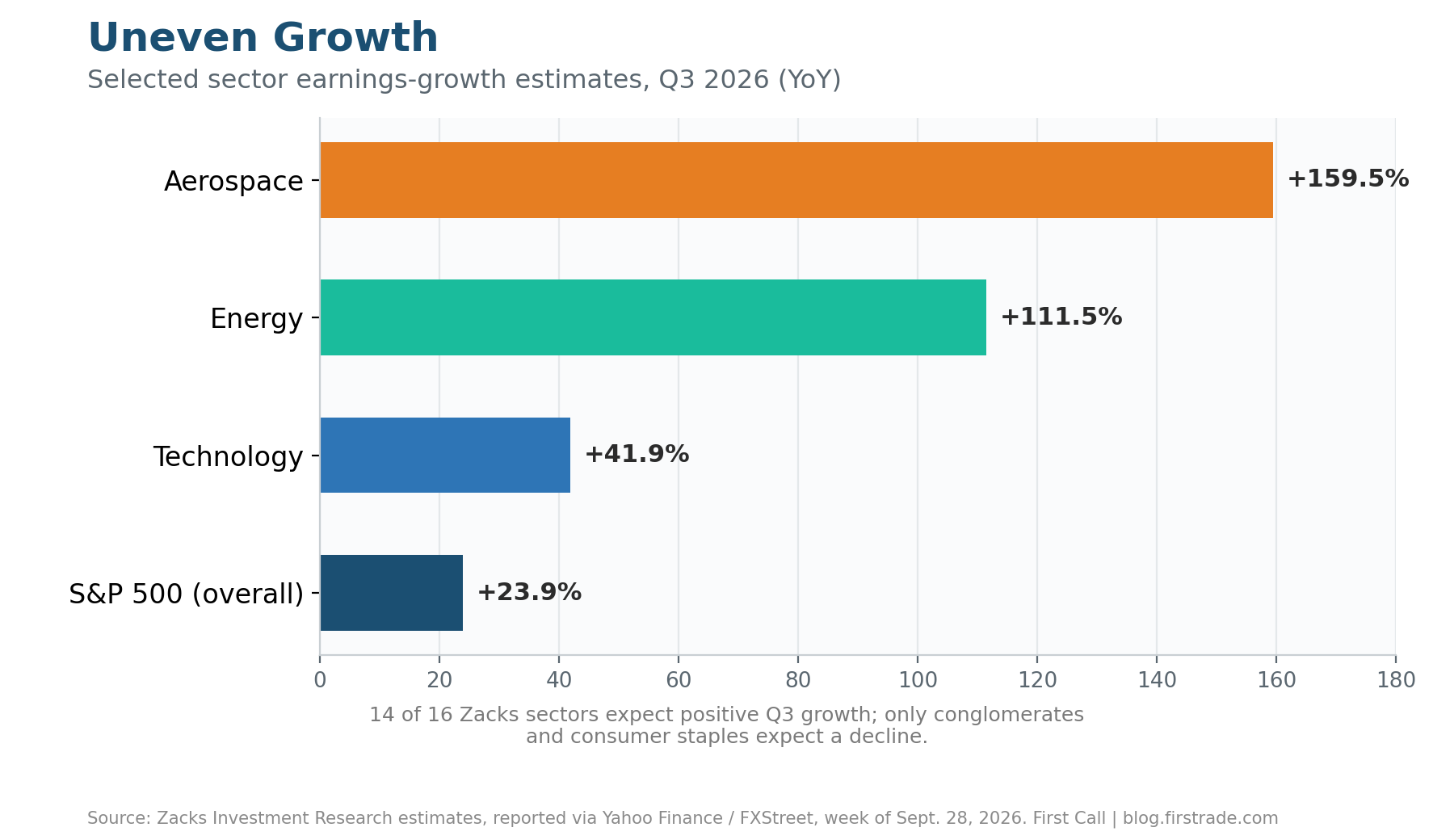
Forecast are estimates and not guarantees.
The growth is real, but it is lopsided. The chart above shows a handful of the sectors driving it: aerospace earnings are projected to grow roughly 160% year over year, energy around 112%, and technology near 42% — against an overall S&P 500 estimate of 23.9%. Fourteen of the sixteen Zacks sectors are expected to post positive earnings growth this quarter; only conglomerates and consumer staples are expected to decline. That is a wide gap to have inside a single index, and it is why a fund's average return this earnings season can look calm on the surface while the pieces underneath it move in very different directions.
What It Means for a Portfolio
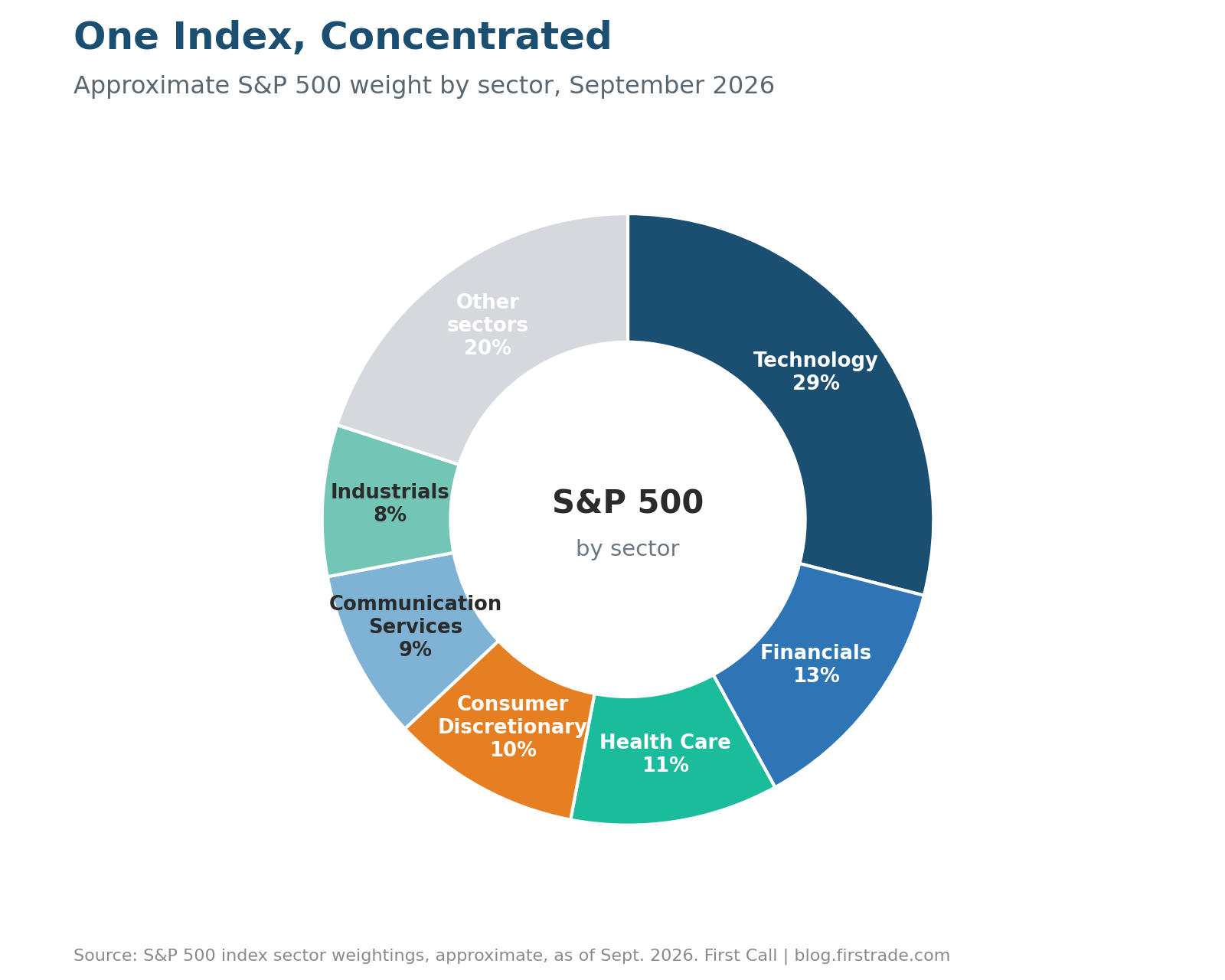
The reason this matters for a passive holding is concentration. The chart above shows roughly how the S&P 500 itself is currently divided by sector: technology alone accounts for close to 30% of the index, with financials, health care, consumer discretionary and communication services making up most of the rest. An index fund or a broad ETF inherits that mix automatically. As a result, investors who buy “the market” may gain exposure to a portfolio with roughly a 30% weighting in technology stocks, whether or not that allocation is their primary objective. It also means that the same handful of sectors driving this quarter’s headline growth numbers are doing much of the work within a typical investment that tracks the S&P 500. Firstrade's Sectors & Industries page charts performance data from the sector level down to individual companies on one page, providing a convenient way to explore sector allocations and company weightings within investments that track the S&P 500.
What to Actually Do About It: Four Steps Before the Reports Land
Before the bulk of Q3 reports arrive in mid-October, it is worth spending a few minutes on where your own holdings actually sit:
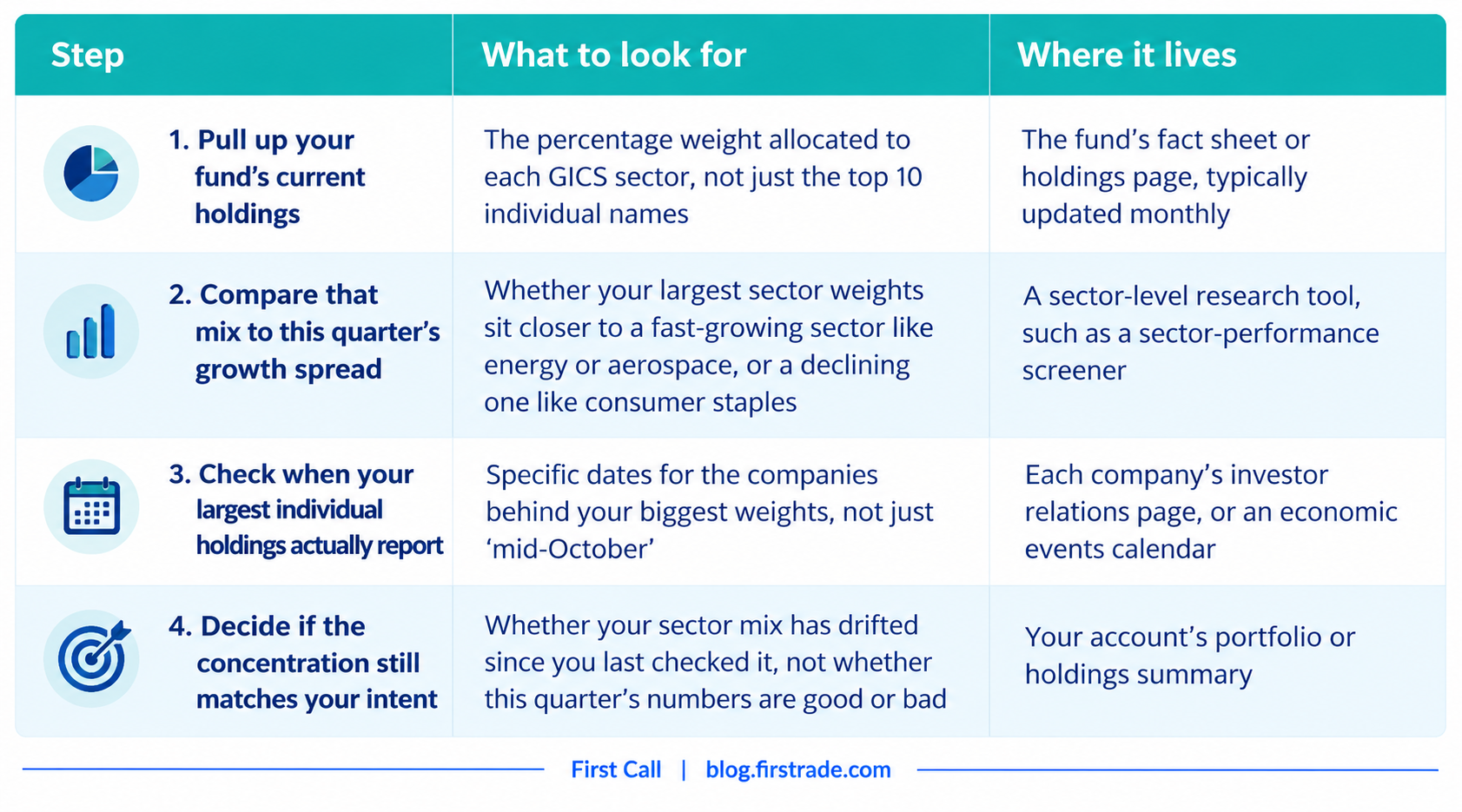
None of this requires trading anything before reports land — the point is knowing what you already own. If a review does turn up a position worth adjusting, that plan only holds up if the adjustment itself is cheap to make: Firstrade charges $0 commission on online U.S. stock, ETF and mutual fund trades, so acting on what you find does not cost more than the finding did.
FAQ
Does a strong earnings season mean the stock market will go up?
Not automatically. Stock prices already reflect what analysts expect; a stock can fall on an earnings report that beats estimates if the outlook attached to it disappoints and rise on a miss if guidance improves.
Why do big banks report before most other companies?
Banks close their books faster than most industrial or retail businesses and have reported near the start of each quarterly season for years; JPMorgan Chase and Bank of America both report in the second week of October this year, on the 13th and 14th respectively.
If I own an index fund, do I need to track every company's earnings date?
No — the point of the exercise above is your fund's largest weights, not every holding. A handful of names typically make up a disproportionate share of any sector-weighted position.
Where do sector-weight numbers like “30% technology” come from?
They are published by the index provider and by the fund itself, and they shift over time as company valuations move relative to one another — checking periodically, not once, is what keeps the picture current.
The Bottom Line
Looking up your own fund's sector breakdown and comparing it to where this quarter's growth is concentrated takes less time than reading one earnings-call transcript. A Firstrade account can be opened online, and the research tools that make this kind of check possible — sector-level data and an economic events calendar — come with the account, alongside $0 commission on online U.S. stock, ETF, mutual fund and options trades. 24/7 customer service is available if a specific holding raises a question the tools don't answer.
This article is for informational and educational purposes only and does not constitute investment, tax or legal advice, or a recommendation to buy or sell any security. Past performance and analyst estimates are not guarantees of future results. Firstrade Securities Inc. is a member of FINRA and SIPC. Investors cannot invest directly in an index. The S&P 500 Index is a market capitalization-weighted index of approximately 500 leading publicly traded U.S. companies.