The Dow Dropped 631 Points on Fed Day: What Your Default Order Type Actually Does, and How to Check Yours in Four Steps
On Wednesday, September 16, the Federal Reserve raised its benchmark rate by a quarter point to a target range of 3.75% to 4.00%, the first increase in more than three years. The vote was unanimous. Stocks had been higher earlier in the session on a stronger-than-expected August retail sales report, and then, in the last hour of trading, the Dow Jones Industrial Average gave all of it back and closed down 631.21 points, or 1.21%.
If you entered a trade that afternoon, the time stamp mattered more than the ticker. The same instruction sent at 2:00 p.m. and at 3:55 p.m. would have filled at meaningfully different prices. That is not a market-timing problem, and it is not something you needed to forecast. It is a question of which order type you used and how long your resting orders have been sitting there, which is one of the very few parts of investing you control completely.
A quiet week with one violent afternoon
Step back a few days and the week barely registers. From Monday to Friday the S&P 500 finished down 0.1%, the Nasdaq Composite finished up 0.7%, and only the Dow moved much at all, down 1.7%. Those are ordinary numbers for an ordinary week.
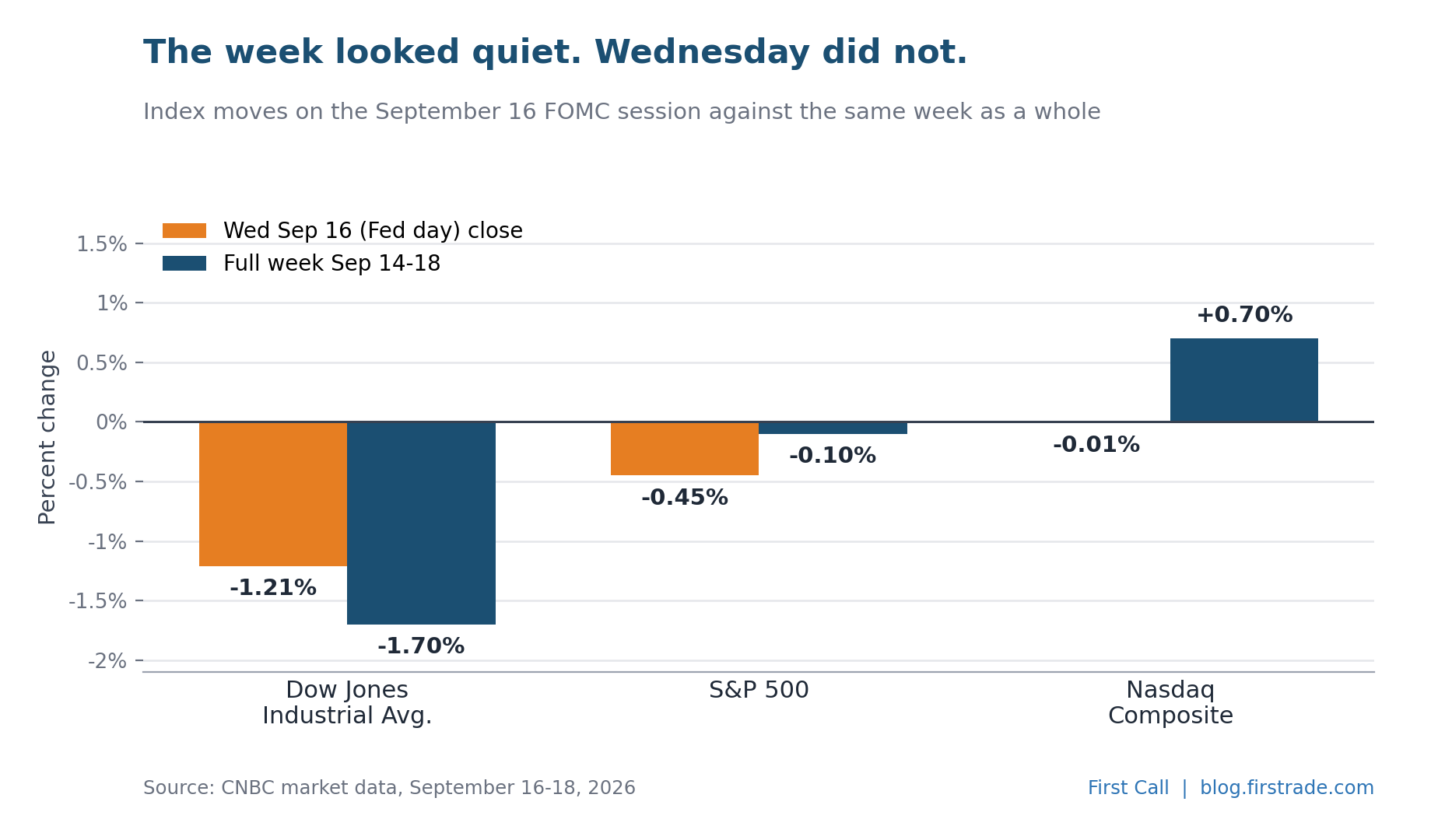
Figure 1. One session against the week that contained it. Source: CNBC market data, September 16-18, 2026. Past performance does not guarantee future results. Investors cannot invest directly in an index.
Wednesday alone tells a different story. The S&P 500 closed down 0.45% at 7,551.81, the Nasdaq was essentially unchanged at down 0.01%, and the Dow lost 1.21%, with most of the damage arriving in the final sixty minutes as Chair Kevin Warsh's press conference landed and updated projections showed 16 of 18 officials expecting at least one more increase this year.
Then the anxiety drained away almost as fast as it arrived. The Cboe Volatility Index closed at 17.71 on Wednesday, 15.44 on Thursday and 14.81 on Friday. By the weekend the tape looked calm again. A weekly chart smooths all of this out. A trade confirmation does not.
What this means for a portfolio
Historical data shows that most long-term investors do not trade on Fed days. But most long-term investors are carrying orders they have stopped thinking about, and a session like Wednesday's is exactly when those orders come to life. Two kinds of exposure are worth separating.
The first is a new order entered into a repricing session. A market order is an instruction to trade immediately at whatever price is currently available. The SEC's investor education material puts the trade-off plainly: a market order guarantees execution, but it does not guarantee price. During an hour in which an index gives up six hundred points, "whatever price is currently available" is a moving target.
The second is an old order still resting on the book. A good-til-cancelled order entered months ago at a level that looked far away can be reached in an afternoon like Wednesday's, and it will execute without checking back with you first. A stop order is the sharpest version of this: once the stop price trades, the SEC notes, the order becomes a market order, which means it inherits every pricing risk described above at the worst possible moment.

Figure 2. Each order type makes one of two promises and declines the other. Source: U.S. Securities and Exchange Commission, Investor.gov.
The graphic above is the whole design decision in one picture. Certainty of execution and certainty of price are separate promises, and no single order type delivers both. Choosing an order type is choosing which one you are willing to give up. A trade confirmation records the execution price and time, so a fill that feels wrong is always checkable after the fact. If the number does not reconcile with the quote you remember seeing, that is a question worth asking a broker with the confirmation in hand rather than reconstructing from memory, and Firstrade offers 24/7 customer service.
How to check your own order defaults in four steps
None of this requires a change of strategy. It is a housekeeping pass, and it is finite: open the last month of order history and your current pending orders, and work through these four items.
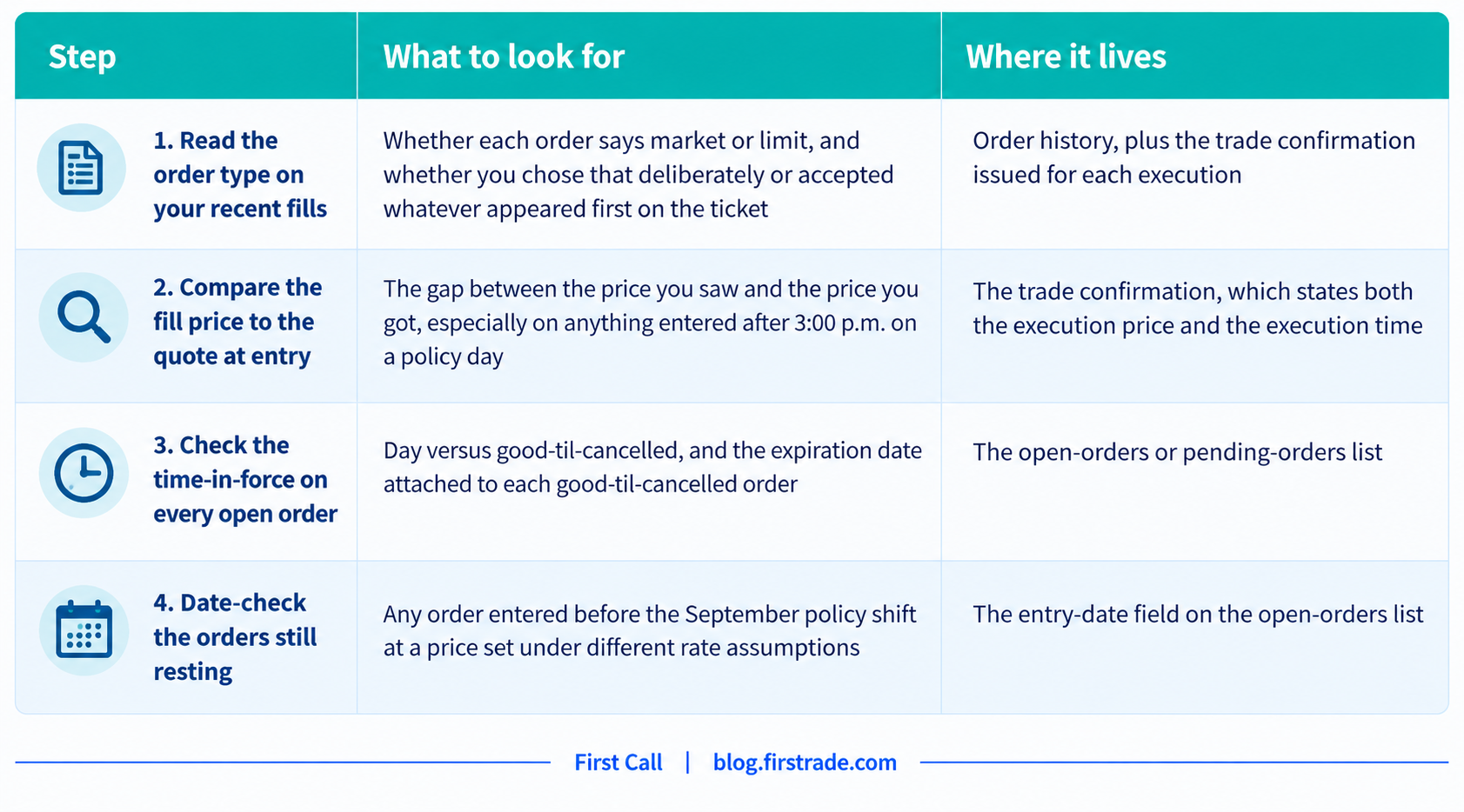
Where step four turns up something stale, the fix is to cancel the order and re-enter it at a level you would choose today, not to leave it and hope. That only makes sense if the act of doing it is free: at Firstrade, online U.S. stock and ETF trades carry $0 commission, which is what keeps routine order housekeeping from carrying a running cost of its own.
The whole review usually takes less than half an hour, and it ends with something most investors have never actually confirmed: what kind of instruction they have been sending all along.
Frequently asked questions
Is a market order ever the right choice?
There are circumstances where certainty of execution genuinely matters more than a few cents of price, and the SEC describes the market order as the tool for exactly that. The problem is not the order type. The problem is using it by default, on a wide-spread security, in a session that is repricing quickly, without having decided that execution certainty was the priority.
What happens to a good-til-cancelled order when the market moves fast?
It behaves exactly as instructed, which is the difficulty. A good-til-cancelled order lasts until it is filled or cancelled, and brokerage firms typically cap how long one may remain open. An order you set months ago reflects the assumptions you held months ago, and a session that moves through your level will execute it against today's conditions rather than those assumptions.
Does a limit order protect me from a volatile session?
It protects the price, not the outcome. A buy limit can only execute at your limit price or lower and a sell limit at your limit price or higher, so you will never be filled at a level you did not accept in advance. What a limit order cannot promise is that it will be filled at all. In a fast market, the honest description is that you have traded the risk of a bad price for the risk of no trade.
How often is this worth reviewing?
Once a quarter is enough for most people, with one extra pass after any week in which policy changed or the market gapped. The September meeting is a reasonable prompt for the next one, because the rate assumptions behind any order set before it have now moved.
The part you actually control
Nobody knew on Tuesday what the last hour of Wednesday would look like, and nothing about order types would have predicted it. What order types decide is what happens to your instructions when a session like that arrives, and unlike the Fed's decision, that part is settled in advance, by you, on a ticket.
Reading your own order history and clearing out the stale resting orders is an afternoon's work, not a change of investment approach. A Firstrade account can be opened online, and once it is, the housekeeping itself costs nothing to carry out: $0 commission on online U.S. stock, ETF, mutual fund and options trades. If something in a confirmation does not add up midway through, 24/7 customer service is there to ask.
Disclosure: This article is provided by First Call for educational and informational purposes only and is not a recommendation to buy or sell any security, nor investment, financial, legal or tax advice. No specific security is recommended. All investing involves risk, including the possible loss of principal, and past performance does not guarantee future results. Market data cited is as of the dates stated and will change. Brokerage products and services are offered by Firstrade Securities Inc., Member FINRA/SIPC. Review Firstrade's brokerage services with FINRA BrokerCheck.
Index Definitions: The S&P 500 Index is a market capitalization-weighted index of approximately 500 leading U.S. publicly traded companies. The Dow Jones Industrial Average (DJIA) is a price-weighted index of 30 large U.S. companies. The Nasdaq Composite Index tracks securities listed on the Nasdaq Stock Market and is heavily weighted toward technology companies. The Cboe Volatility Index (VIX) measures the market's expectation of 30-day volatility based on S&P 500 Index options. Investors cannot invest directly in an index.