
Today is November 2, and 2026 has two months left. The IRS announced last year's retirement-account limits on November 13, 2025, and as of the IRS newsroom list that runs through October 29, 2026, no release announcing 2027 limits has appeared. For most savers the number that matters this week is therefore still the 2026 one. Payroll deferrals count toward the year in which the wages are paid, and only a handful of pay dates are left. This article sets out the 2026 limits and ends with a four-step check that turns them into a per-paycheck figure you can read straight off your own pay stub.
What the 2026 Limits Are
The IRS release IR-2025-111 sets the 2026 elective deferral limit for 401(k), 403(b), governmental 457 and Thrift Savings Plan accounts at $24,500, up $1,000 from 2025. Most plans also allow a catch-up of $8,000 for savers aged 50 and over, and the higher catch-up for ages 60 to 63 stays at $11,250. The IRA limit rises to $7,500 from $7,000, with a $1,100 catch-up for those 50 and over. IRS Notice 2025-67 also lifts the Roth catch-up wage threshold from $145,000 to $150,000; that threshold decides whether catch-up contributions must be designated as Roth, so it is worth confirming with the plan administrator. Chart 1 sets the two years side by side.
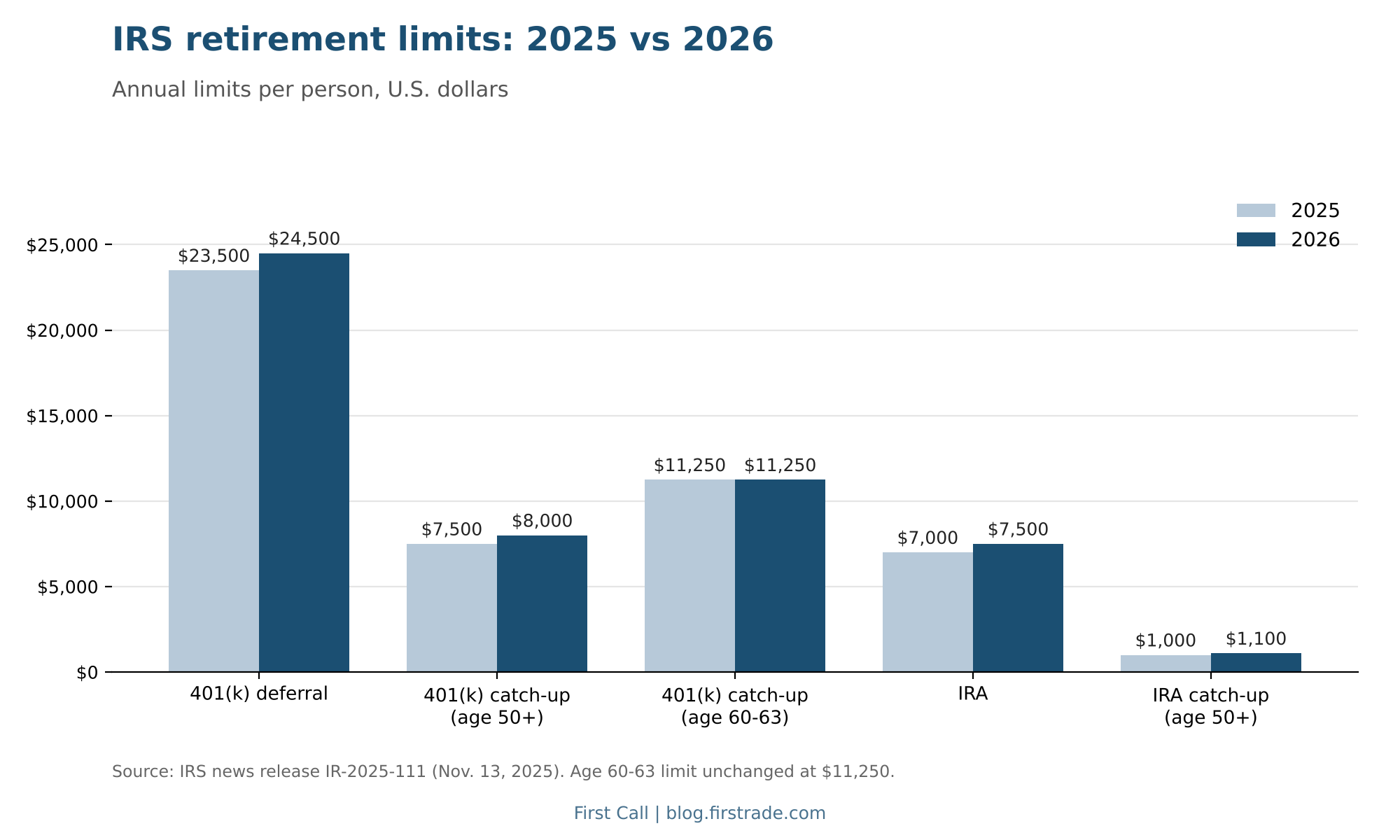
Chart 1: IRS retirement limits, 2025 vs 2026. Source: IRS news release IR-2025-111 (November 13, 2025).
What the Limits Mean for Your Own Accounts
The deferral limit belongs to the person, not the plan. Someone who changed jobs this year and contributed to a 401(k) at both employers is measured against one $24,500 figure, not two. An IRA is a separate allowance: money put into one does not use up room in the other. Employer matching contributions are not counted against the employee deferral limit; they fall under a separate overall limit that the IRS also publishes.
The practical question is the gap. Suppose a saver has deferred $14,000 through October. That leaves $10,500 before the limit, and how heavy it feels depends on the pay calendar: $5,250 per pay date on a monthly schedule with two dates left, $2,625 on a semi-monthly schedule with four, or $1,312.50 on a weekly schedule with eight. Chart 2 lays out the arithmetic. For an IRA held at a brokerage, the year-to-date contribution total is a number worth confirming with a person rather than estimating, and Firstrade offers 24/7 customer service.
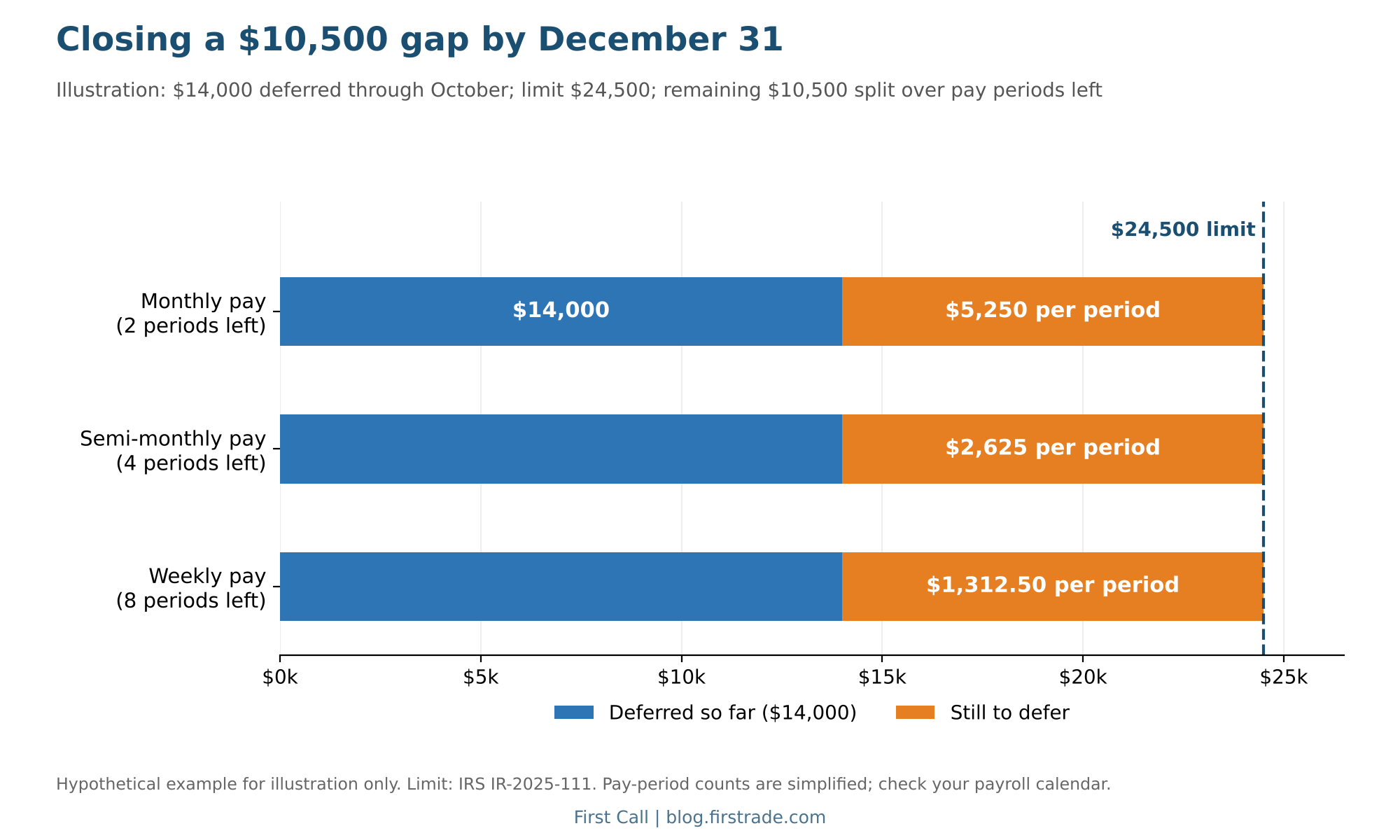
Chart 2: A hypothetical $10,500 gap divided across the pay dates left in 2026. Illustration only; limit per IRS IR-2025-111.
Two details about the pay calendar change the math. A new deferral election normally applies from a future pay date, so a change requested today does not reach this week's paycheck. And a pay date that falls in the first days of January pays 2027 wages, so it counts toward the 2027 limit, not this one. Your employer's payroll calendar settles which dates are really left.
What to Do About It: Four Steps
The check takes four lookups and one division. Nothing in it requires deciding to contribute more; it only tells you where you stand.
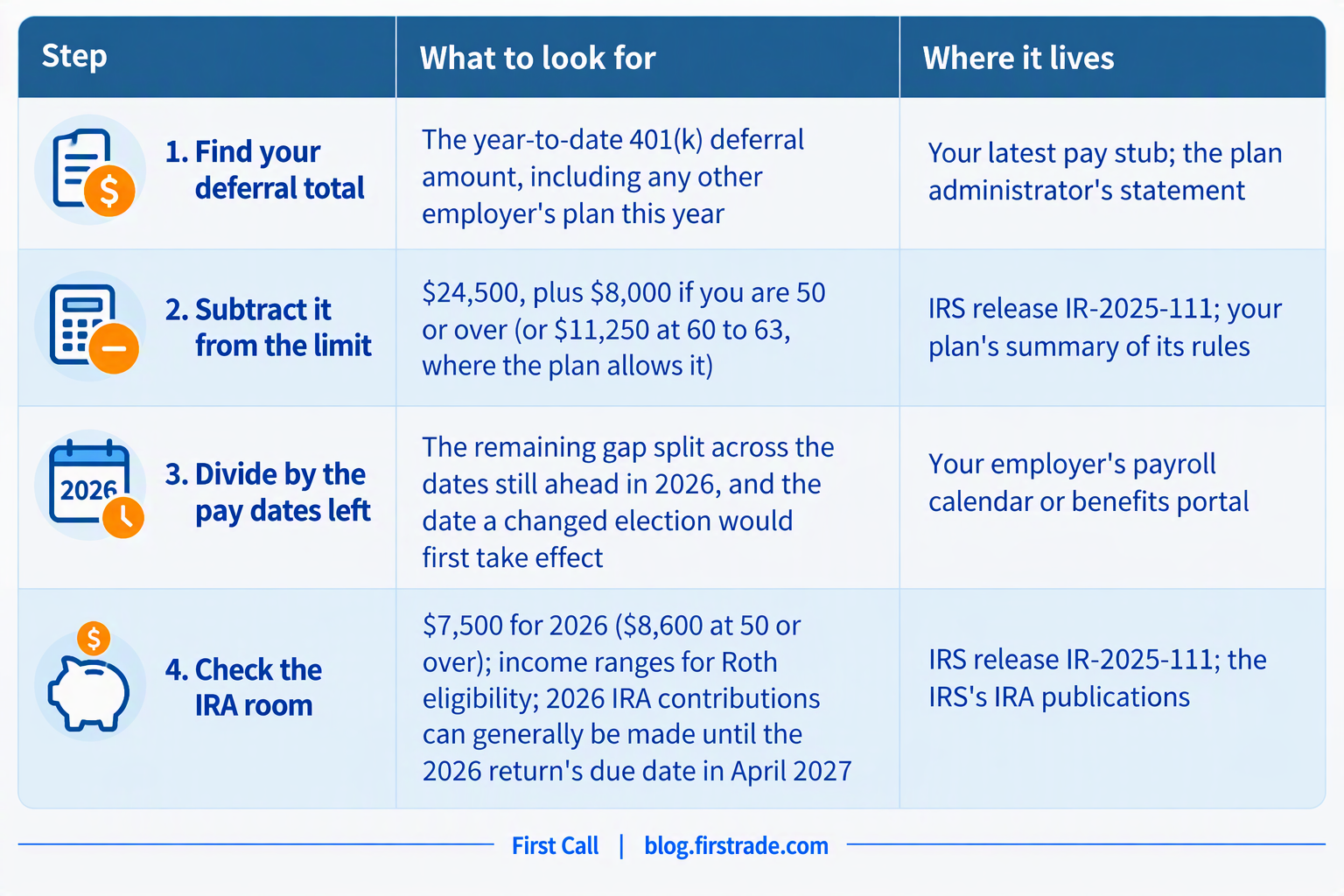
Roth IRA eligibility phases out between $153,000 and $168,000 of income for single filers and between $242,000 and $252,000 for married couples filing jointly, per the same IRS release. A deduction for a traditional IRA has its own, lower ranges if you or a spouse are covered by a workplace plan. Splitting a contribution into several smaller deposits only makes sense when trades inside the account are not charged each time; Firstrade charges $0 commission on online U.S. stock, ETF, mutual fund and options trades, with no options contract fees.
None of the four steps asks you to contribute more. A saver who is already on track will find a gap of zero in step two, and that is a useful result too. If your employer matches contributions, read the plan's matching formula before lowering any deferral, because the match is usually tied to a share of pay that you contribute.
Frequently Asked Questions
When will the 2027 limits be announced?
The IRS has not said. Last year's announcement was on November 13, 2025, and a newsroom list through October 29, 2026 shows no 2027 release yet. Whatever the new numbers are, 2026 deferrals still count against the 2026 limit.
What happens if I contribute more than the limit?
The usual cause is having plans at two employers in the same year. Excess deferrals have correction rules and deadlines, so the plan administrator is the first call, and a tax professional can explain the tax treatment.
Do I need to change anything for 2027 now?
Not for the 2026 limit. A new 2027 figure only matters for payroll elections that begin in January, so the deferral percentage you set for next year can wait until the number is published.
Where to Start
A contribution gap is an arithmetic problem with a December 31 deadline, and the four steps above settle it in one sitting with a pay stub in hand. If step four points to an IRA, an account at Firstrade can be opened online, and once it exists, trades carry $0 commission online for U.S. stocks, ETFs, mutual funds and options, with no options contract fees. If a question comes up midway, 24/7 customer service is available.
This article is for informational and educational purposes only and does not constitute investment, tax or legal advice, or a recommendation to buy or sell any security. Investing involves risk, including possible loss of principal. Tax rules, limits and thresholds change, and individual circumstances differ; consult a qualified tax professional. Firstrade Securities Inc. is a member of FINRA and SIPC. Firstrade does not offer tax advice, always consult your own tax advisor for your situation. See pricing for complete information.